ENG

On this photo: Desantniki - the Russian Airborne Assault troops (VDV) - preparing to embark Mi-8 helicopters that were to carry them to the Hostomel Airport, early in the morning of 24 February 2024, on a road in the Gomel area of south-eastern Belarus.
Hi everybody!
While trying to catch with all the latest news about this war, have found myself immersed into reading stuff related to the ‘4th anniversary’ of Putin’s all-out invasion of Ukraine, too. The coming week, I’ll be so busy, right now I’m not sure I might manage to write anything related. Thus, better earlier, than not at all.
Indeed, have caught myself reading and thinking about two particular features. An article in The Guardian explaining how the CIA and MI6 were warning the Ukrainian (and European) leadership of the coming Russian invasion, back in 2021, and everybody was skeptic and thus didn’t listen. And then… no, I’ll not add a link: grew fed up of internet wars with all the wiseacre Experten already back in 1995 (yes, have had the internet already then, no matter what you ‘believe’ or not): sufficient to say, it’s an analysis by a Western analyst of the critique of the Ukrainian leadership expressed by a Russian political scholar…
In order of appearance…
As much as most of the content of the article in The Guardian was known to me, one way or the other (an exception would be the notion that Zaluzhny and other commanders were holding back out of fear they might get, to keep it simple: ‘court-martialed’), it’s still a feature I cannot but recommend reading and then saving. And then re-reading at every opportunity: it’s simple, easy-to-follow, and to the point (especially in comparison to the way I think and tend to describe ‘things’).
The essence of the story is that neither of two ‘top’ (foreign) intel services of the USA and the UK might have had a ‘smoking gun’, or any kind of a ‘super-spy’ within the ranks of the Pudding Administration. However: the summary of what they’ve got was so crystal clear that only one conclusion was possible.
Still, this conclusion was turned down by ‘European partners’ (not only the Germans and the French: even the Poles were skeptical, at least initially), because it was ‘making no sense’ - to them (especially not to Germans). And, because it was not making sense to the Europeans, Zelensky also ended up mistrusting the US-Americans and the British. Sure, Zelensky has had his own, additional reasons for his point of view: in a much compressed summary, one could describe these with ‘domestic politics’. Points of view like ‘preventing panic’ and (the resulting) ‘collapse of the economy’.
‘Even’ with hindsight, it’s still hard to accept it: Zelensky refused to trust all such reports - and that right until the Russians attacked. Indeed, the invasion caught him - and his Minister of Defence, too - sleeping at home. Just like the boss of the German BND was caught sleeping in a hotel in Kyiv, pending a number of meetings with Ukrainian counterparts, planned for that 24 February. And because Zele refused to act, Zaluzhny’s hands were tied: he and the top brass of the ZSU didn’t dare violating the President’s orders. Thus, seems, even the recall of the Operational Reserve 1 and 2 of the ZSU, reportedly issued on 18 or 19-, and then 22 February, respectively, seems to have been ‘rather unofficial’ by nature. If it really took place at all. As result - and regardless what is which of their-, or any other Ukrainian claims stressing ever since (read: usual statements are something like, ‘we knew they are coming’ etc.) - the ZSU was caught asleep as well. Typically, only Budannov and the HUR were ‘something like prepared’ - though Zele wouldn’t listen even to them.
…and then, even once they did start reacting, nobody in Ukraine expected the Russians to attack not only Kyiv, but also drive into Kherson and Zaporizhzhya, and from there to drive into the back of Mariupol’s defences, which proved fatal for the latter.
To make sure: went back to check my own assessments from ‘those times’. Regardless what was published around, as of November 2021, I was skeptic, too. Even making jokes. ‘It didn’t make any sense’. Have started changing my mind only in January 2022, when sat photos surfaced in the social media showing that the VSRF began deploying its field hospitals and blood-banks close to the border. The scope of that element of the deployment was ‘simply too much’. Nobody is deploying as many field hospitals and related equipment without actual intention of ‘doing something’. That was when it became obvious: Pudding is going to invade.
I didn’t know it at the time (got it ‘confirmed’ only by this article in The Guardian) - but: it now turns out I was not alone in assessing that the Ukrainians are unlikely to manage continuing to resist beyond two-, perhaps three weeks. Indeed, this was the primary reason why even once the Russians did invade, not only the ‘Europeans’, but the USA and the UK too, were hesitant to deliver anything else than ‘heavy infantry weapons’. See: man-portable air defence systems (MANPADs) and anti-tank missiles like FGM-148 Javelin… and 5,000 kevlar helmets. Stuff suitable for enabling the ZSU infantry to continue fighting - for example: in form of a guerrilla war - regardless what happens in Kyiv or along the frontlines.
Essentially, all the talking heads were all waiting to see what happens with Ukraine during these first two-three weeks. That’s why it was so ‘pleasant’ to hear reports about successful Ukrainian defence of Voznesensk, in the first days of March, for example, and then the ‘first’ (known to me at the time)) Ukrainian counterattacks, in the area west/north-west of Kyiv, about a week later.
That was when it became obvious: ‘they’ (Ukrainians) are going to resist, fiercely, and no, Russia can’t win.
DISCLAIMER: at least not the way Pudding planned to win…
Which is bringing me to the next point.
There is one detail - and then something related to ‘planning’ - in that article in The Guardian that is making it ‘special’: less so of interest for ‘such weirdos and/or nerds’ like me, but for you as readers not directly involved in monitoring and analysing this (or any other) war.
I’m drawing your attention at this detail because it’s nicely explaining how did Pudding manage to plan the operation - without ever informing the majority of characters from his inner circle; not even top command nodes of the VSRF. After all, it is ‘well known’ (at least to such like me) that not only characters like Peskov and Lavrov, but even such top military command and control instances like the headquarters of the Joint Strategic Commands (OSKs) Zapad (West) and Jug (South) of the VSRF were informed about the decision to invade only some two, at most three days before this was to be initiated. Their direct subordinates - commanders of such ‘field armies’ like, for example, the 35th Combined Arms Army (CAA), or the 41st Combined Arms Army - were informed even later. In turn, many of their subordinates: only hours before they’ve had to drive out. And the troops at the bottom of the chain of command: not at all.
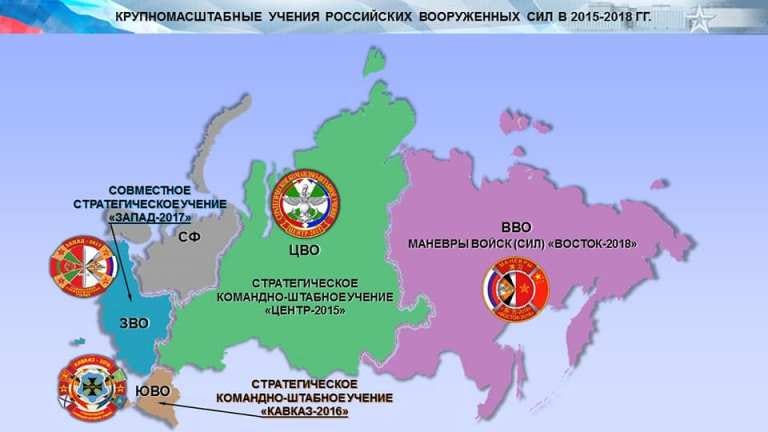
A map of Russia describing the zones of responsibilities of the five OSKs. Marked in blue and with the inscription ‘ZVO’ (i.e. what looks like ‘3VO’) stands for the OSK Zapad/West; marked in orange, and with the inscription ‘JVO’ (looks like ‘HVO’) is the OSK Jug/South. At least nominally, it was these two command nodes that were in charge of the Russian military invasion of Ukraine.
Why is this as important?
Because Pudding was working in perfectly ‘standard’ fashion. Has ‘simply’ tasked the Main Operations Directorate of the GenStab in Moscow - specifically: a team led by Colonel-General Sergei Rudskoi - with planning the invasion of Ukraine.
Now, the authors (and the editor) of that article are making a mistake of pointing out Rudskoi as the, ‘best-informed person inside the general staff’. Sorry, but that’s a massive exaggeration. At most: ‘something for public consumption’. Making it easier to attract attention and for uniformed readers to follow.
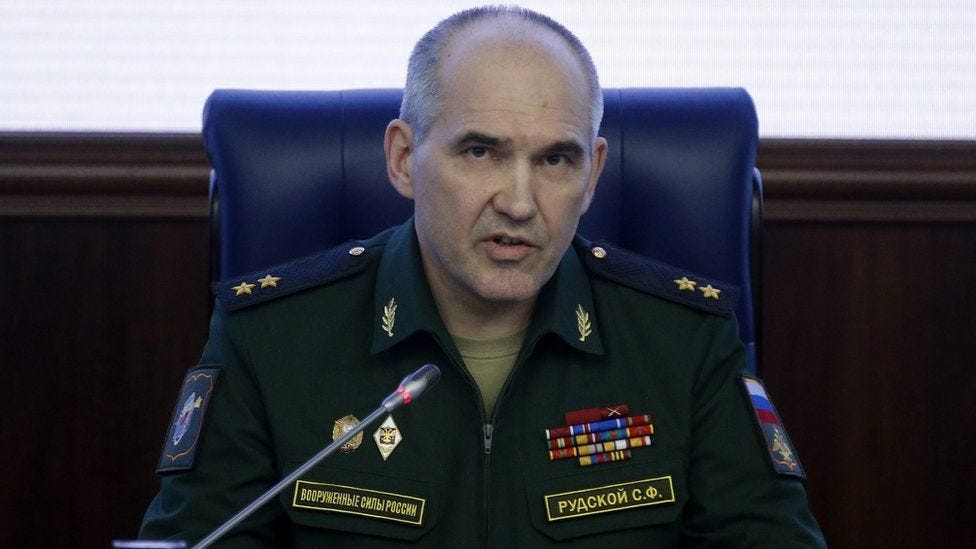
To weirdos like me, Rudskoi is known as the chief strategic planner of the VSRF. The very reason for the existence and the core essence of his job is to plan for any kind of eventualities. He - and his team - is/are paid to (and has/have got nothing else to do), to plan anything that might happen to Russia, from natural catastrophes to all sorts of military affairs, be these an internal mutiny, or an invasion by the Mars People… to a Russian invasion of Ukraine, or specific operations within frame of the same.
This is not making him ‘the best-informed person inside the general staff’. Far from that. Rudskoi (and the team) only knows what is his/their job and what has he been told to plan: he (and the team) must have drawn thousands of plans over the years. It doesn’t mean Rudskoi knows what of plans he (and the team) has drawn is going to be realised. He only knows what has he been ordered to plan. There is, actually, only one person deciding what is Russia - and, specifically, the VSRF - going to do, and that is Pudding.
For example: sometimes in spring of the last year, Rudskoi must have been ordered to develop a plan for advance and seizure of Kupiansk. Or, more recently, at least sometimes this winter, Rudskoi must have received the order to develop multiple plans ‘for Zaporizhzhya’. One, two or more, for an advance on the city; at least two additional ones for an assault on the city; and at least two other plans for a siege of the city. All he knows is that he’s been ordered to develop such plans. And, based on his military education and experience (and the same of his team), plus intelligence obtained and provided by the GRU (military intelligence service of the GenStab in Moscow) he/they can then calculate what and how many units, with what and how many troops to plan to deploy, in what (general) directions to order them to advance, how many supplies, ammo etc. to prepare, how to organise logistics, how to keep them resupplied etc.
What of his/their resulting plans are then going to be used (it can easily become just a part of one or another of his plans), and what is going to be realised… that’s still ‘in the stars’.
(In turn, when the time comes - that’s on Pudding to decide, and Gerasimov then to follow Pudding’s orders - any plan drawn by Rudskoi and the Main Operations Directorate, is then forwarded to the HQ of the OSK South, which, since summer of 2022, and after Gerasimov, is the principal command authority for all the Russian operations in Ukraine. In turn, the HQ OSK South then prepares more detailed plans and issues corresponding orders to the COs of its fields armies, etc., etc., etc.)
Point is that this ‘detail’ draws attention to a simple conclusion: Pudding had no problem maintaining security of his intention - at least inside Russia. It is ‘perfectly normal’, perfectly ‘peace-time routine’, to task the Main Operations Directorate with planning this or that. This is not only the case in Russia: you can be sure, there are similar bodies in any other armed force around this world (additionally: there are similar bodies in the HQs of such alliances like NATO), doing the same job, and having a plan for any kind of eventualities. I’m sure, for example, somewhere in some forgotten corner of an office in the GenStab-U, there is also a plan for an Ukrainian invasion of the Russian Federation.
Because that’s the very nature of why such HQs are existent.
…except that some details of what Rudskoi/Main Operations Directorate then planned, have been ‘intercepted’ by the CIA and/or the MI6, one way or the other. In attempt to rise the political- and public awareness, starting in November 2021, these then began ‘leaking’ carefully scrutinised details to diverse media platforms.
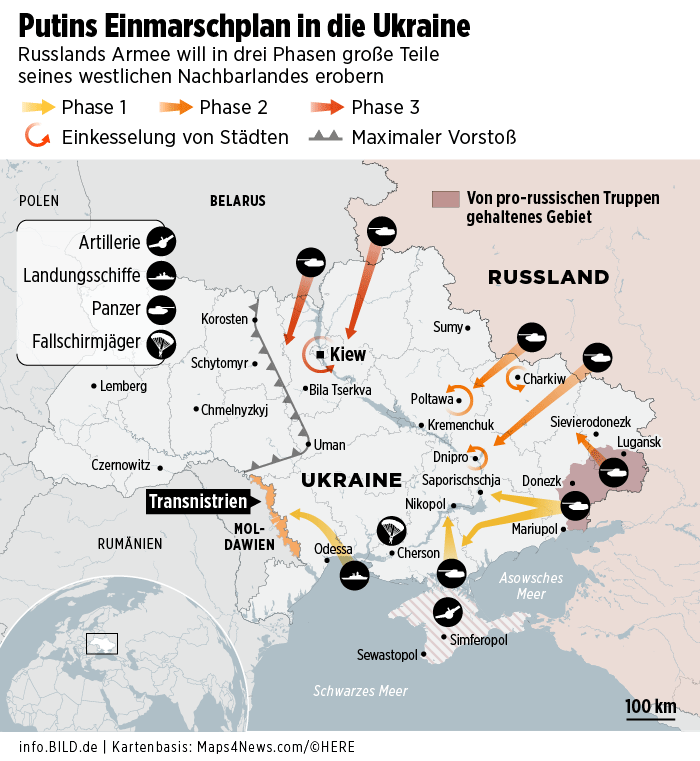
One of examples for the US and British intel ‘leaking’ their information to the mainstream media - in a vain attempt of influencing the politics and the public opinion. In November 2021, the German tabloid Bild has published this map of the plan for the Russian invasion of Ukraine. One can discuss if this or that detail is ‘correct’ - especially because this plan was based on overoptimistic assumptions and the VSRF then failed to realise it - but: the essence is clear and the dependability of information is beyond any doubt.
Still, except for the White House and Downing Street 10, nobody took them seriously enough…
As mentioned at the start of this feature, the other article that caught my attention was that discourse about a Western analyst reviewing (quote) ‘harsh critique’ expressed by a Russian analyst - and that in reaction to a specific article in the Western press.
Sounds complex, thus I’ll have to explain to some degree.
The Russian analyst explained something like ‘typical story’: Ukraine was preparing for this war ‘for decades’ (indeed, quote: ‘deliberately prepared for a war with Russia for more than thirty years’), yet, due to problems with mobilisation and logistics, it turned out it is unprepared for large-scale combat operations; then the Russia’s effectiveness in drone warfare took it by surprise; while the weak coordination within the Ukrainian (top) command doomed Ukraine to fail.
Sigh… why am I even paying attention, you might ask?
For the very same reason like always. Because when one is monitoring wars and warfare in serious fashion it’s crucial to understand what and how are the people running that war ‘ticking’. What do they think? What do they find important? What matters to ‘them’? This is what’s driving their decisions. Ignoring somebody and something ‘just because’ he’s Russian, Vanuatuan, or from Mars, is simply wrong. Indeed, in the case of the Russian analyst in question: it’s decisive to find out what kind of the advice he might (or might not) offer to Pudding (even if it’s ‘around five or more corners’).
Above all, it’s not like if the Russian analyst in question is entirely wrong. On the contrary. For example, he began with explaining how after the collapse of the Union of Soviet Socialist Republics (USSR; colloquially ‘Soviet Union’), ‘Ukraine inherited a massive military stockpile designed to support prolonged autonomous warfare by large troop formations’. However, so the analyst, over the following decades, ‘the mass of the equipment in question was either sold off or looted, while Ukraine’s defence industry - comparable in potential to Russia’s of the early 1990s - degenerated below any acceptable degree’.
Feel free to deny this, but this is a simple matter of fact.
What’s worse: with hindsight, it’s obvious that ‘even’ the steps taken by successive Ukrainian top political leaders in charge since the initial Russian invasion in 2014, were… not just ‘too little’, but, hopelessly insufficient. Sure, the overall readiness of the ZSU was improved (back in February 2014, its commanders struggled to put together a single operational battalion, cobbled together from elements of at least three brigades): already by 2015, the armed forces were made capable of ‘containing the terrorist threat in the Donbass’. However, by now it’s crystal clear ‘even to the sparrows on my roof’ that nobody in Ukraine took care to prepare the ZSU for facing what it is facing since 24 February 2022.
…sometimes because it was ‘making no sense’, but many times for plenty of other reasons. Including such like Zelensky’s insistence (pre-evalent even as of early February 2022) that any rising of the level of preparedness of the ZSU would only escalate tensions and provoke Pudding to attack. And - damn me for stating this (yes, ‘again’), but it’s another matter of fact - when ‘the President doesn’t care’, why should anybody in charge of the armed forces ‘risk his skin’ to act differently?
Another point by the Russian analyst is also valid: Kyiv’s overreliance on ‘the West’. He wrote that (quote), ‘from the outset, Ukrainian authorities assumed that the West, viewing Ukraine as an instrument of pressure against Russia, would provide everything necessary - funding, weapons, and even direct military involvement’.
Now, perhaps it is so that not one of Ukrainian presidents really expected the USA and/or NATO to - in the case of a Russian invasion - go fighting for Ukraine. And, arguably, I’m not sure if Zele is really (and still) falling for illusion of any kind of a NATO military intervention on behalf of Ukraine. However, the rest of this statement is yet another matter of fact. Zele was not the first Ukrainian president to fall for illusions like expecting ‘the West’ is going to defend Ukraine from any kind of a Russian invasion. Should there be any doubts in this regards, please permit me to remind you about something called the ‘Budapest Memorandum on Security Assurances’, from Anno Domini 1994.
Sorry but, due to experiences of the last 4-11 years, can’t but laugh at this point - because Zele is still (and yet another Ukrainian president) insisting on ‘the West’ issuing additional similar guarantees… and, matter of fact is also: he’s not the first to continue failing to make Ukraine capable of defending itself on its own. On the contrary, the country is nowadays more dependent on ‘the Western’ aid than ever before.
The Russian analyst is also right in regards of the weakness of Ukrainian command structures. Also in regards of the decline in troop morale. Are two directly related factors: idiotic failures in leadership have caused deep dissent between the troops. While my impression is that, ‘generally’ (I cannot precisely quantify) Ukrainians remain eager to resist, they also say, they’re ‘not crazy to let themselves get killed by some idiotic general’. Moreover, the Russian analyst is right in concluding that ‘Russia’ (read: the Keystone Cops in Moscow, i.e. the GenStab there) has (quote), ‘increased its operational competence during the fighting in Ukraine’. It did. Even ‘dramatically’. And, especially in comparison to the Glavcom and the GenStab-U in Kyiv. The principal reason why the Russians are still ‘advancing’ (read: grinding forward) in this war is because they have learned to exploit every single of Ukrainian weaknesses. And there are no more weaknesses in Ukraine, than at its (political- and) military top.
Where, me thinks, the same Russian analyst is erring are such issues like that (quote), ‘the West expected Russia to collapse quickly under sanctions’. I doubt this. It ‘merely’ underestimated the effectiveness of empty threats with sanctions in order to deter Pudding from invading.
Where the Russian analyst is ‘right on money’, is his statement that ‘the West’ did not plan for long-term support of Ukraine’. Even now, four years since the all-out Russian invasion, there is still no coherent strategy for how to defeat this invasion. There’s merely certainty that the EU-part of NATO is going to continue financing corrupt incomptenets in charge of Kyiv for another two years.
Finally, where the Russian analyst is ‘right’ is that the nature of ‘Western policy’ is (quote), ‘egoistic: it’s using allies for its own interest’.
Even the Ukrainians in charge have meanwhile realised it: no, ‘the West’ is not going to prioritise Ukraine’s interests over its own. Because the zombie idiots in the West are not only in their positions because their financiers know them as loyal and reliable, but because they know nothing else but to maintain the status quo.
Bottom line: yes, ‘Ukraine still holds’.
By how much… we’re going to see.
What I’m sure is that this is nothing Ukrainian leaders can boast about, nor praise themselves with. I’ve said it already back in 2023, and I’m going to repeat it: yes, Ukraine holds - DESPITE its incompetent leadership.
Foremost, after four years of this, and although simply having to add specific ‘spice’ to their texts - that’s the very nature of the System Putin: either one is loyal, or falling down the stairs, then out of a window at the end of the stairs - Russian analysts are ‘getting real’. And, keep on calling me a ‘pessimist’, if you prefer, but I would say: we better get ready for not just another four years of this war: based on experiences from underestimating intelligence assessments of 2021 and early 2022, I would go as far as to say, we need to prepare ourselves for much worse things than ‘the war in Ukraine is just going to go on’. Not only because of failures of Ukrainian leadership, but especially because our own leaders - here in ‘the West’ - are still failing, every single day, to prepare our countries (and Ukraine) for any other ‘outcome’.


.jpeg)