ENG


“It will happen on April 1, and it won’t be funny” — Russians began threatening to completely ban Telegram back in February. And since Crimeans first experienced issues with the “un-Kremlin-friendly” messenger last summer, they took the threat seriously and were fully prepared: with verified, working VPNs and a clear intention to ignore the state-sponsored alternative to Telegram — the Max app. “When they started hyping up this story about the final block, I immediately said that nothing would change for us at all — they’ve been trying to block it for good since last summer, when they started forcing everyone into Max. Well, practically nothing has changed: everything works through a VPN, if the VPN is decent,” one of the Simferopol students shared with CEMAAT.
However, the occupiers have also stepped up their fight against VPN services that allow users to bypass Russian bans. They even managed to “take down” some of them on the last day of March. But, as it turned out, this wasn’t a problem even for inexperienced users. “I had this little-known Italian VPN; that’s probably why they didn’t block it for a long time. But they got to it too — it stopped working. There’s a cell phone store nearby, at the bus stop; I went in there, and for a hundred rubles they installed a new app for me. Everything’s working again, and so far without any problems,” says a pensioner from Yevpatoria with a smile.
However, not in all areas did the “final de-Telegramization” proceed so routinely and unnoticed. Telegram’s countermeasure cleverly cornered the blockers into a situation where attempts to throttle user requests began causing banking services to fail. “We were really looking forward to this ‘day of reckoning’; it was interesting to see how Durov (Telegram’s founder—Ed.) would respond to the blocking. Judging by how banking services froze up, he chose to mask the traffic, and somehow managed to redirect some of the blocks to legitimate requests in the financial sector,” says a Crimean IT specialist.
Indeed, on April 3, the Russian bank VTB “crashed” in Crimea for several hours. In various regions of the peninsula, according to residents, it was impossible to pay by card at terminals, ATMs “didn’t recognize” the cards, and logging into the app was completely impossible. “I’d kill them, those idiots! They’ve banned everything around here! I went to the pharmacy to buy medicine for my child, and at the entrance they told me that if I had a VTB card, I could just go on my way. It’s a good thing I still had a card from another bank that worked,” a resident of Kirovske said indignantly.
Another consequence of the announcements about blocking the messenger was an exodus of subscribers from propaganda Telegram channels. Most platforms, despite their “patriotism,” did not stop operating on the enemy platform, but their audience began to shrink. For example, the FSB mouthpiece, the “Crimean SMERSH” channel, lost about 1,500 subscribers over the weekend alone, and “shrunk” by approximately 5,000 over the course of a week.
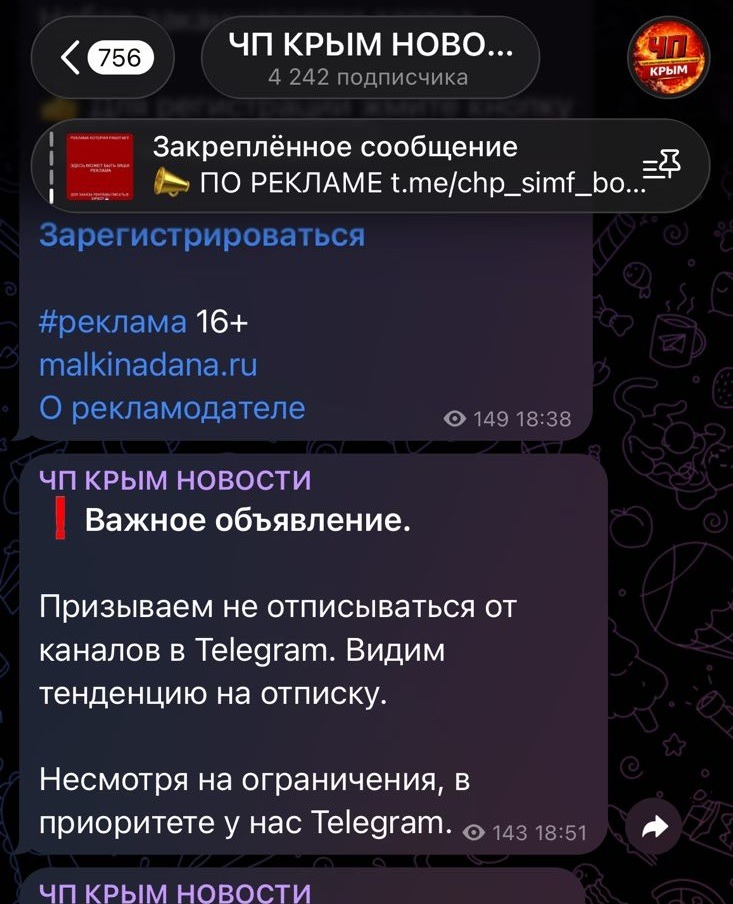
The pro-Russian public group “Emergency / Crimea | News ” did not try to hide this problem. The editors published a statement urging their subscribers not to leave the channel, because despite government measures to restrict Telegram, this platform remains a priority for them. They also noted that they were seeing a “trend toward unsubscribing.”
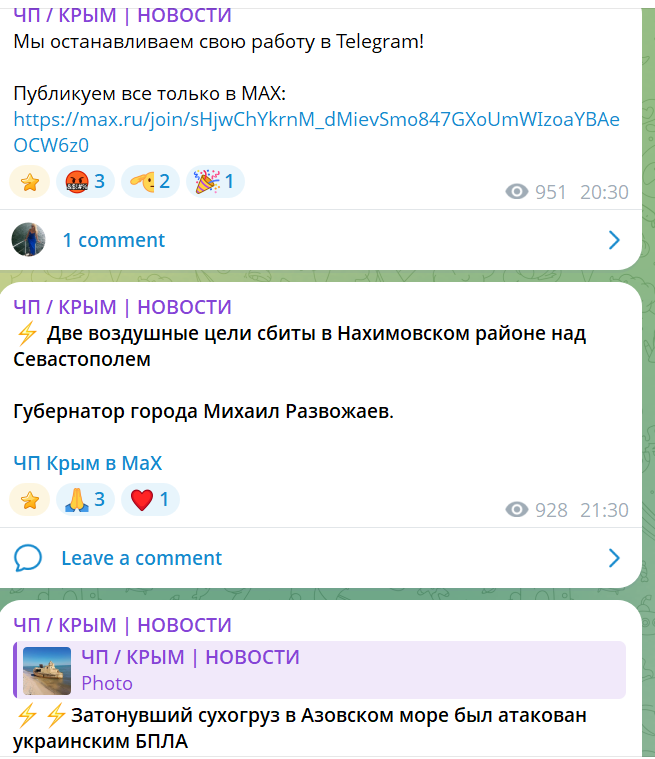
On the same day, another channel, “Emergency / Crimea,” announced that it was ceasing operations on Telegram and would publish exclusively on Max. But after that, as if nothing had happened, it continued to post news on the banned platform. Local residents attribute this “volatility” to the unreliability of the Russian state-run messenger. “Max crashes so often that I don’t know who would seriously consider it a replacement for Telegram. Just yesterday, the group chat glitched, and today I see the car sales public channel isn’t working. Who’s going to invest their time and effort into a platform that’s so glitchy?” wonders a Bakhchysarai entrepreneur.
However, Crimean human rights activists do not rule out that, over time, all these Telegram channels with a Russian agenda will be forcibly shut down to demonstrate a unified stance toward Telegram as an enemy platform. “It’s just not all at once. Once the outrage over the blocks dies down, they’ll gradually start pushing their propagandists into a fully controlled sandbox. This, by the way, will limit the ability of outside observers to monitor human rights violations, since, unlike Telegram, a Russian SIM card is required to register the Max app” predict activists from the Telegram project “Tribunal. Crimean Episode.”
But overall, many residents of the occupied peninsula are skeptical about the Russian authorities’ technical capabilities to completely block Telegram. They believe this is possible only if the region is completely cut off from the internet, since there are simply no other technical solutions that cannot be circumvented. “They didn’t shut down Telegram in three days. Everyone who wanted to has long since learned to live under constant censorship and whatever additional difficulties. I recently caught myself thinking about how easily we adapt to new bans and how quickly we find safe ways to circumvent them,” sums up one Sevastopol resident regarding the blocking attempt.