ENG


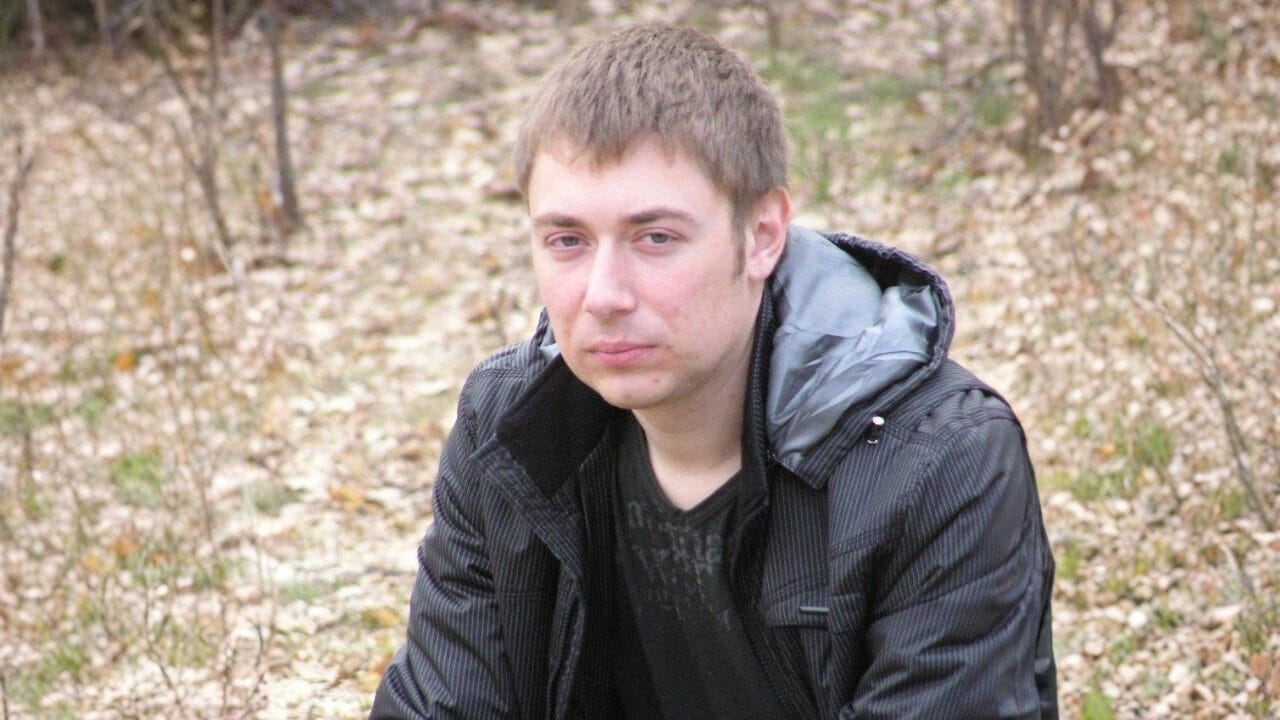
Mariana Bukhan is a Ukrainian journalist who has been investigating the issue of prisoners of war and civilian captives held by the Kremlin since 2016. Her article for the Media Initiative for Human Rights is dedicated to Valentin Vyhivsky, one of the first Ukrainians abducted by the Russians in Crimea and imprisoned for 11 years.
Valentin Vyhivsky, a 43-year-old Ukrainian, spent 8 of those years in solitary confinement in a Russian prison. In the fall of 2014, he traveled to occupied Crimea for a single day, where he was seized by FSB officers and accused of “espionage.” Valentin Vyhivsky was unlawfully convicted and sentenced to 11 years in a penal colony. The Kremlin’s captive served his full sentence and was due to be released in the fall of 2025. But the Russians did not release him. Instead, they sent him to one of the temporary detention centers. The International Center for Human Rights (MIPL) managed to speak with Valentin online; he described how he fell into the trap, the years he spent in captivity, his disappointment, and his hope to see his son and parents again.
“You can’t scare a rabbit with a carrot” — that’s how Valentin Vyhivsky responds when asked if he’s afraid, while on Russian territory, to talk about his time in Russian prisons.
This is our first conversation with Valentin, although his story has been known in Ukraine for over 10 years — he was one of the Kremlin’s first civilian prisoners. Our conversation takes place via a social media messenger app. The connection frequently cuts out, but that doesn’t prevent us from learning, in just a few hours and in detail, how he lives now, how he managed to endure years in solitary confinement at the “Utrobyno prison” (the unofficial name for FKU IK-11 of the Federal Penitentiary Service of Russia in the Kirov Region, located in the city of Kirovo-Chepetsk and the village of Utrobyno — author’s note), and how he envisions his return to Ukraine.
He Fell into the Hands of the FSB Because of “Damn Compassion”
In early 2014, Valentin Vyhivsky was a Kyiv-based entrepreneur involved in car tuning. But he refers to his business simply as a way to make money. His true passion was aerospace engineering, the design of aircraft engines, and avionics. Valentin explains that aviation and airplanes themselves didn’t interest him much; what fascinated him was how everything worked inside aviation systems and engines. He devoted a lot of time to studying this subject, participated in numerous online forums, and had many acquaintances among both professionals and enthusiasts in the field.
Valentin also took part in the Revolution of Dignity. He recalls that after the people’s victory on the Maidan in late February 2014 — and following the start of the annexation of Crimea and the war in Donbas — he had a heated discussion on political topics with a Russian man on one of the forums dedicated to programming and avionics. Valentin could not have imagined that this very conversation would likely cost him his freedom for years to come.
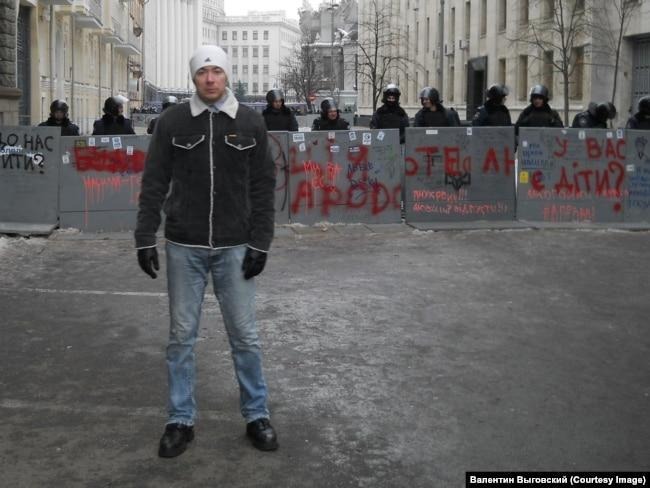
Valentin Vyhivsky during the Maidan in Kyiv
In the summer of 2014, an old friend from the Moscow region — who was also part of the aviation enthusiast community — reached out to Valentin. She told him that her grandfather was seriously ill and asked him to lend her 4,000 euros for his treatment. The woman had one condition: Valentin had to bring the money to Crimea in person. He says that at first his friend’s request seemed strange, but he couldn’t ignore it or refuse to help.
“This compassion for people has let me down before. It’s a painful subject for me. My intuition told me it was foolish, but I did it anyway. And that damned compassion cost me dearly,” says Valentin.
$150,000, over 30 FSB agents, and a private plane
The meeting with his acquaintance was scheduled for September 16, 2014. That day, Valentin arrived in Simferopol by train — it was one of the last direct trains running between the Ukrainian capital and Crimea. He had no plans to stay on the annexed peninsula, so he immediately bought a return ticket and headed to the meeting. The woman had arranged to meet him at the outdoor seating area of a café near the Simferopol airport.
As soon as Valentin saw his acquaintance, unidentified masked men struck him in the face and knocked him to the ground. They silently dragged him into a room, stripped him, and declared that Valentin was suspected of espionage. The Ukrainian was interrogated for two hours and then put on an AN-74 plane bound for Moscow.
The flight from Simferopol to the Russian capital took not one hour — the usual duration of the route — but three. For half that time, the Ukrainian recalls, they beat him, then they removed the bag from his head and explained: they wanted him to see with his own eyes that the “special operation” to uncover the “spy” involved more than three dozen operatives who had flown in specifically on a government plane, and that all of this allegedly cost the Russian budget 150,000 U.S. dollars.
They staged a mock execution and pressured him to serve “the motherland”
In Moscow, Valentin was taken to “Lubyanka” — the FSB headquarters, which even back in Soviet times was a symbol of political repression, torture, and secret interrogations. He recounts that when he refused to sign a confession, the investigator sent him to the FSB operatives. They took him out to the woods. There — once again — a bag over his head, beatings, the rattling of assault rifle bolts, and prolonged silence. Valentin calls this a form of psychological torture, where no one threatens to shoot him or yells, but simply makes it clear in silence what lies ahead.
And then — back to Lubyanka, where the investigator explained briefly:
“If you resist, you’ll get 18 years in prison. If you confess — 11 years. Whatever number we write in the case file for the judge, that’s the sentence you’ll receive.”
Valentin signed the confession. He was transferred to the “Lefortovo” pretrial detention center — yet another Russian correctional facility where they primarily hold “political” prisoners or those whom the Russian FSB considers a threat to the Russian Federation.
For a year, they “fabricated” a case against Valentin there — they brought him to the investigative office several times and even claimed they were conducting an investigative experiment. However, no one explained to the prisoner why they were doing this in Moscow if the suspect had allegedly been spying in Crimea.
Sitting in a cell at “Lefortovo,” Valentin Vyhivsky wondered how and why they had chosen him specifically for this fabricated case. Then he recalled both an argument with a forum participant over allegations regarding rights and freedoms in Ukraine and the strange behavior of his so-called acquaintance, who had lured him to Crimea.
Valentin concluded that at the start of the Russian-Ukrainian war, FSB officers — whether they wanted to or were simply following orders — were tasked with identifying Ukrainian “saboteurs” and “spies,” and were rewarded for doing so. And he had fallen into their trap.
As the court hearings drew nearer — and especially during the trial — FSB representatives approached Vyhivsky five times with offers to cooperate. It was then that Valentin learned: even before luring him from Kyiv to the annexed peninsula, the Russians had hacked into his computer and found a wealth of information there regarding aeronautical engineering. In an effort to persuade him to work for the Russian intelligence services, they called him an important and experienced specialist and offered him freedom. Each time, Valentin refused.
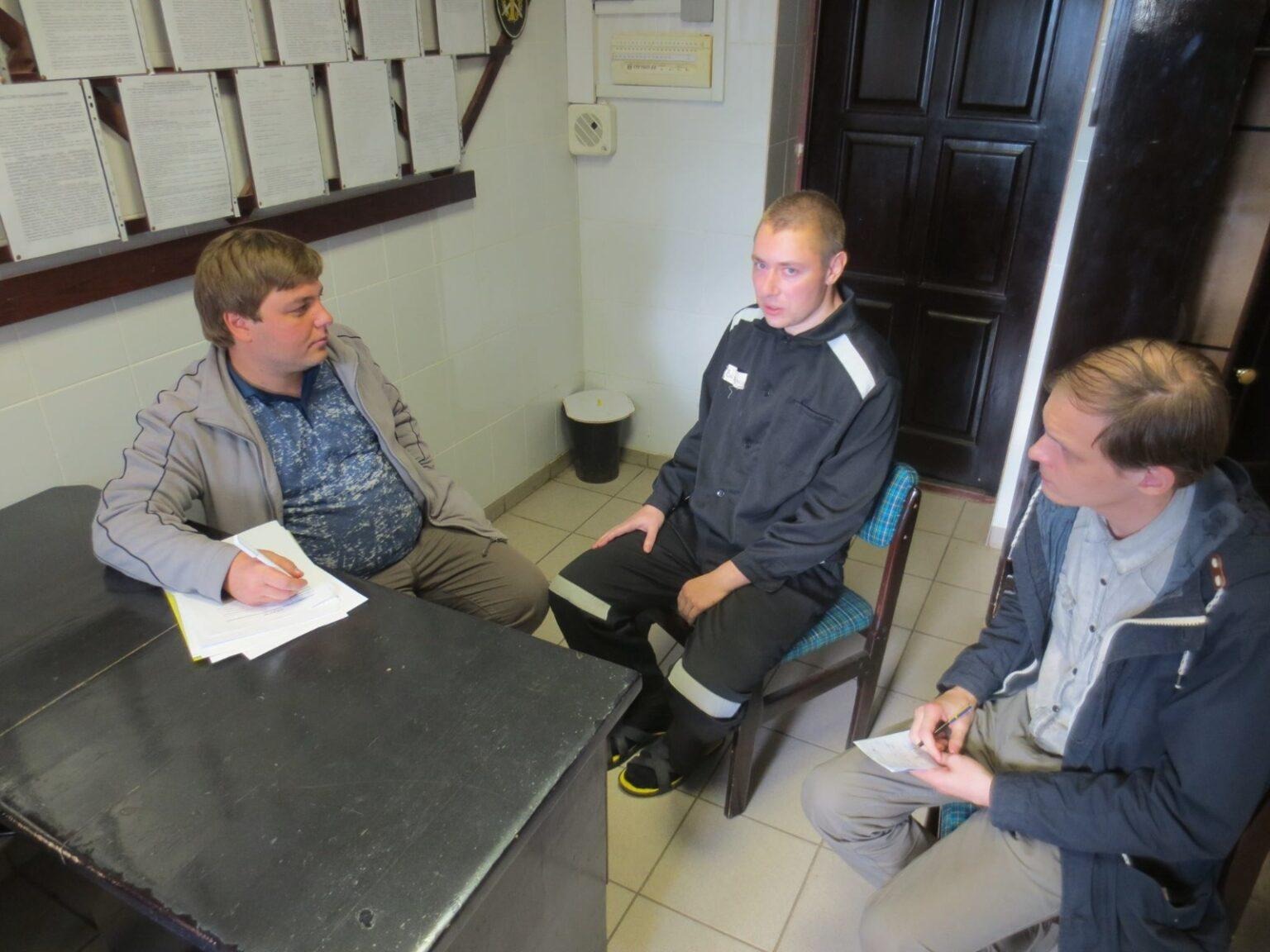
Vyhivsky in the Kirov Court of the Russian Federation, September 2015
As the FSB agents had promised, the court found Vyhivsky guilty and sentenced him to 11 years in prison. During the sentencing, Valentin says, the Russian state prosecutor made him yet another offer:
“Young man, why sit in prison?! You’d be better off serving ‘the motherland’!” Then he paused and added: “…it doesn’t matter which ‘motherland’.”
Recalling this episode, Valentin says that in conversations with operatives, FSB investigators, and judges, he constantly heard the assertion that Ukraine is part of Russia. And they were very surprised that Vyhivsky himself thought otherwise.
“They told me many times that Ukrainians are Russians too — it’s just that right now we’ve kind of lost our way,” Valentin says with a mix of anger and laughter.
8 Years in a Solitary Confinement Cell
Valentin Vyhivsky ended up at Penal Colony No. 11 in the village of Utrobino, Kirov Oblast, in late 2015 — after his court verdict and an unsuccessful appeal. There, the Ukrainian was sent to solitary confinement. As Vyhivsky asserts, this was an order from the FSB. It was in solitary confinement that he spent 8 of his 11 years. And he calls this long period the hardest experience of his life.
“You know, there’s a punishment for convicts called SHIZO (punitive isolation — author’s note). It’s a solitary confinement cell where inmates who violate prison rules are sent. Usually, it’s not for long — just a few days or weeks. Because humans are social beings. But for me, it was a punishment that lasted 8 years. In solitary confinement, a day drags on like a week. Even now, I feel like I’m 80 years old.”
Valentin describes how he struggled with long periods of depression. And at some point, he realized: you just have to zone out, not think about where you are, but instead keep yourself occupied every minute — reading, writing letters, or jotting down your thoughts. So he subscribed to as many newspapers and magazines as possible.
The Kremlin captive’s spirit was shaken quite severely when, in 2019, Valentin learned from his parents’ letters that an exchange had taken place, in which 11 civilian captives, among others, had returned to Ukraine (the 35-for-35 exchange took place on September 7, 2019 — author’s note).
“I was very disappointed in Ukraine because they seemed to have forgotten me, as if I’d been abandoned; it hurt,” Valentin replies succinctly when asked how he reacted to the news. He does not wish to speak at greater length on this subject.
Full-Scale War
When Russia’s full-scale invasion of Ukraine began, Valentin Vyhivsky had already been transferred from a solitary confinement cell to a facility known in Russian prison slang as “under the roof.” This facility has separate rooms where inmates sleep and a common area where they spend the day, socialize, and can watch Russian television. That’s exactly how Valentin found out about the invasion.
“And I lost it! I didn’t hold back in the comments. And when I received *Novaya Gazeta* the next day, and there on the front page was the damaged wall of my house in Kyiv… You see, I recognized it! It was painful.”
As a result, the other inmates complained about Vyhivsky to the prison administration. He was sent back to solitary confinement — this time for a month.
New Prisoners
Valentin Vyhivsky endured yet another ordeal around the summer and fall of 2023, when prisoners from “Azovstal” were brought to the penal colony. He recounts this in harrowing detail.
“They were housed in a separate section, but on the same floor where I was. At the same time, the very same staff who had treated me more or less normally were tormenting these guys. I didn’t see it, but I heard it.”
Valentin was strictly forbidden from communicating with the prisoners of war. But it was clear how hard it was for them. They were beaten and poorly fed — given small portions that had to be swallowed in two minutes. And this was at a time when Valentin himself was given both enough food and half an hour for each meal.
“You’re cannibals! Tormenting prisoners — karma will come back to haunt you for this!” — Valentin once shouted this at the prison guards from his cell. To which he received a response laced with profanity: “Keep it up, and we’ll do the same to you.”
“Prison is a place where conditions can always get worse. And you might think you’ve hit rock bottom, but you haven’t,” says Vyhivsky.
Release, but Not Freedom
Valentin’s prison term expired in mid-September 2025. By law, if a person has served a sentence outside their home country, they must be deported. By the time of his release, Valentin’s passport had already expired. He could not renew it in Russia: Ukraine had severed diplomatic relations with Russia as early as February 24, 2022.
On September 17, 2025, Vyhivsky was transferred to a migration center in the city of Kirov.
“The migration center is just like a prison, but the conditions are easier. The staff is more ‘friendly,’ and the cell has a shower; they give you a TV and a phone every day. It’s a 4-star hotel!” he laughs.
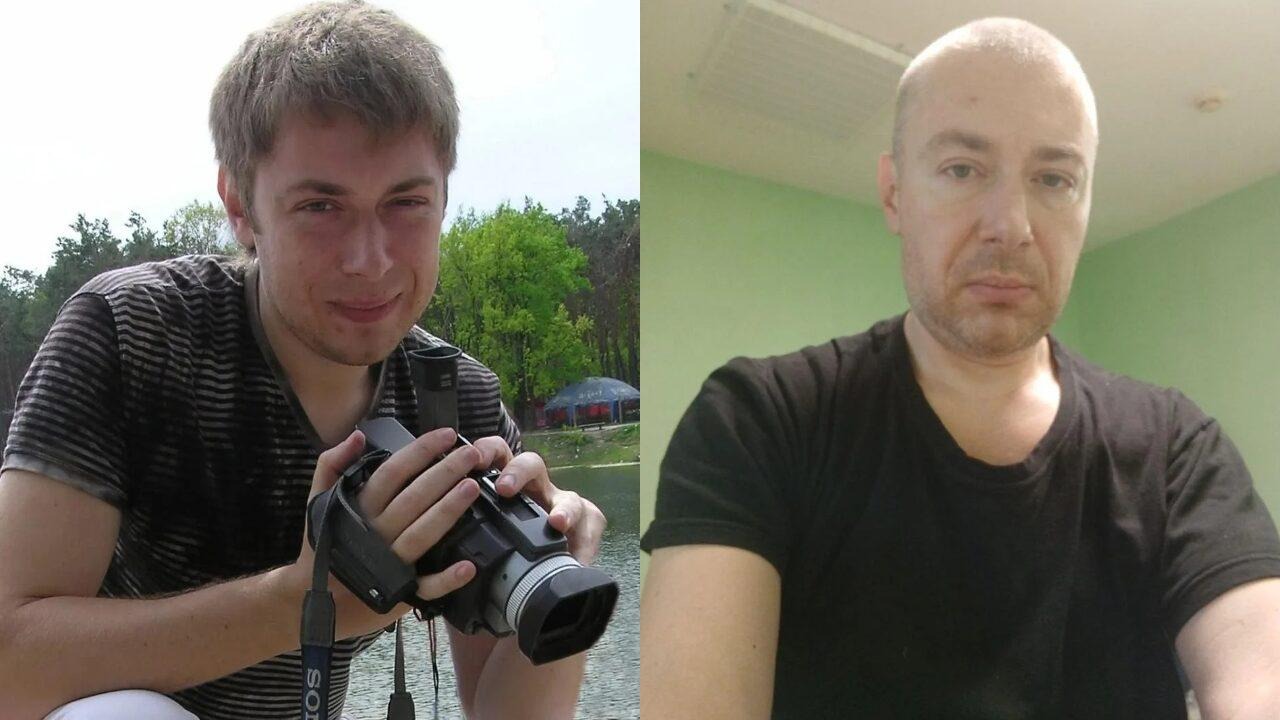
Valentin Vyhivsky before his Russian captivity (left) and after eleven years of imprisonment (right). Photo from the family archive
After his time in prison, Valentin actually came to like this place, even though the windows had the same bars and the doors had the same “food slot.” But he saw people who were brought to the migration centers from the outside, and, according to Vyhivsky, they complained that they had ended up in a real prison.
Valentin’s reprieve didn’t last long either. Every four months, he is now taken to court, where officials hand down the same ruling: Vyhivsky cannot be released.
“They mock us, saying that there’s a war going on in your country, so, they say, we can’t let you go back there, and as if there’s no part of the border where you can cross from Russia into Ukraine.”
Who is demanding Vyhovsky’s release?
Valentin’s parents and son are waiting for him at home in Kyiv. For years, Petro Vyhovsky has participated in rallies in support of the release of prisoners of war, written letters to every authority, and spoken out at every possible forum, calling for Valentin to be returned from a Russian prison to his homeland.
With the outbreak of full-scale war, Petro explains, the family simply waited for Valentin’s prison term to end, believing that he would then be able to come home.
After September 17, 2025, when his son was not released, Petro Vyhivsky appealed to the Ukrainian Ombudsman and the Coordination Headquarters for Prisoners of War and Missing Persons — these two bodies are currently responsible, among other things, for the return of civilian captives. For a year now, Petro has been receiving the same response: “We are working on the issue of his return.”
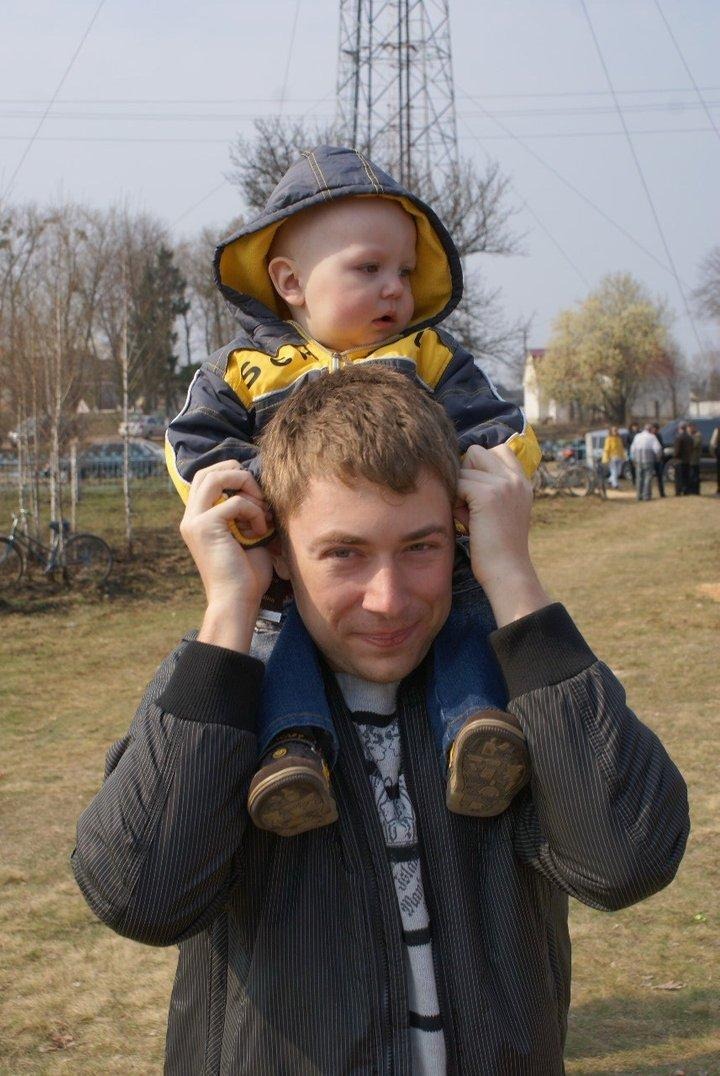
Valentin Vyhivsky with his young son. Photo from the family archive
“I do not doubt that they’re working on it, but not diligently enough, in my opinion. During one of our regular meetings, one of the officials asked me for some reason how I’d rate their work, and without waiting for an answer, he said himself: ‘If your son were home, I suppose the rating would be excellent.’”
While communicating with various human rights organizations, Petro Vyhivsky learned that there is allegedly an order from the head of the Russian Investigative Committee, Bastrykin, prohibiting employees of the Russian penal system from handing over Ukrainian civilians of draft age who are being held to the Ukrainian side.
“I was told that this information is classified and for internal use only; apparently, Bastrykin’s order states that for the next two years, only the sick, women, and children may be released, while healthy and young men are to be held in these deportation centers,” says Petro Vyhivsky.
The MIPL has previously reported that Russia does not release Ukrainians who have served their sentences in Russian prisons. Instead, one prison is simply replaced with another — such individuals are sent to temporary detention centers for foreign nationals. There, they can remain “stuck” for years.
What’s next?
Valentin Vyhivsky filed an appeal against the Russian court’s latest decision to keep him in Russia, but his appeal was denied. He is currently preparing a cassation appeal.
He says the only thing he can do is fight to return home. And he hopes that people in Ukraine won’t forget about him and will also keep pushing for his release.
“I ended up here before my son even started school, and now he’s a freshman in college. He’s 1.90 meters tall — already taller than me — and of course, I want to see him,” Valentin says, sharing his greatest wish.


