ENG

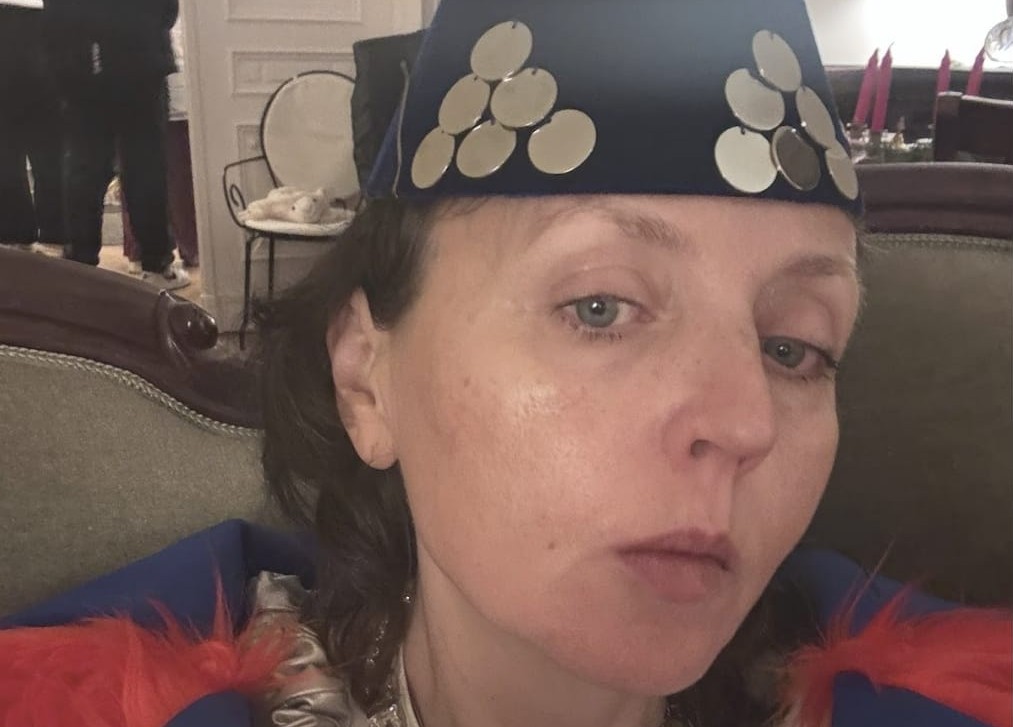
Leo Efetova is a German citizen, researcher, and Karaim activist. You can read more about them here, and today we are publishing an article by Efetova on the occasion of an event held in the German capital on the eve of the International Day of the World’s Indigenous Peoples. This day is commemorated worldwide on August 9.
Ahead of the International Day of Indigenous Peoples on August 7, a council convened in Berlin to discuss the future of the indigenous peoples of Crimea. This story reminded me of my work in the field of rare diseases — where patients are so rare that most doctors are encountering their symptoms for the first time. This often leads to fatal outcomes due to improper treatment.
As the years go by, the disease progresses — sometimes irreversibly. That is why diagnosis is one of the cornerstones of this field — and it requires a comprehensive medical history, as well as a consultation involving various specialists. But this is impossible without interviewing and examining the patient.
We, as the indigenous peoples of Crimea, find ourselves in a situation where even the slightest mention is already seen as a success. We are far from being in a position to choose, and even if we are dissatisfied with how we are represented — the fact remains: our names have been spoken. Even if it was without us.
The Crimean Tatars, Crimean Karaims, Krymchaks, Urums, and Rumeans — the five peoples of the Black Sea region — have much in common, but also differ in terms of population size, status, and resources. A failure to understand this leads to numerous panel discussions turning into pointless talk — which, at best, leads nowhere.
Three Levels of the Same Curve: Ukrainians, Roma, and the Peoples of Crimea
Ms. Usik, a member of the Berlin Parliament and a member of the Committee on Youth and Family Affairs for the CDU, offered advice to representatives of the indigenous peoples of Crimea. Her party’s conservative stance in recent years has sparked outrage among Berliners due to the cancellation of grants for numerous intercultural, youth, and inclusive projects. Nevertheless, Usik won the election precisely on the issue of supporting Ukrainian refugees. Drawing on this experience, she offered her advice to the Crimean Tatar diaspora — emphasizing the need to integrate into German society in order to preserve Crimean culture. Usik also advised Crimeans, Karaims, and others to raise their public profile and participate in politics by collaborating with members of the Bundestag.
This revealed a complete lack of understanding of the demographics. Refugees from Crimea were distributed mainly to states in southern Germany; they are scattered across various cities. In Berlin itself, there are barely a dozen representatives of the indigenous Crimean peoples — and half of them are already public figures: they publish, give speeches, and organize events.
I would like to add that “integration” has been criticized in German political circles for several years now and is being replaced by the concepts of inclusivity and “Teilhabe” (participation). The difference between these terms is that “integration” implies that only newcomers must make an effort to adapt to their new environment, whereas “inclusion” builds bridges and takes into account the specific characteristics of migrant groups — for example, through intercultural projects.
First level — Ukrainians
The figures clearly illustrate why it is important to take this distinction into account when it comes to small, marginalized groups. As of March 2026, there were approximately 1.34 million Ukrainians registered in Germany with temporary protection — and an entire infrastructure has been built around this status: cultural centers, crisis assistance centers supported by the Ukrainian diaspora and the embassy, and academic programs such as the DAAD center, which receives multimillion-euro funding from the German Foreign Ministry. This entire system communicates and teaches in Ukrainian.
On Saturdays and Sundays, a whole network of Ukrainian schools operates in Germany — nonprofit initiatives made possible by parental contributions, where children are taught the Ukrainian language, literature, and “cultural heritage classes” alongside their regular German school curriculum. This model works when there is a critical mass within the diaspora. A community of one million people is capable of building such a network from the ground up on its own.
The second level — Roma
In general, German foundations can identify minority groups within the Ukrainian refugee population: the EVZ Stiftung operates a separate support program for the Romani community, recognizing its vulnerability and its history of the Holocaust. Overall, there is a network of specialized organizations in Germany dedicated to this marginalized group, providing targeted assistance to Roma refugees from Ukraine — taking into account language and cultural barriers as well as the risk of discrimination. Roma Center e.V. and the Roma Antidiscrimination Network (RAN) provide advice on registration, finding housing, and processing documents via a hotline (also available on WhatsApp and Viber) in Romani, Ukrainian, Russian, German, and Serbian. The Documentation and Cultural Center of German Sinti and Roma and the Central Council of German Sinti and Roma are coordinating emergency assistance and monitoring cases of anti-Roma discrimination, working to ensure the equal integration of refugees. Support includes initial orientation at train stations, assistance with visits to government agencies (Ausländerbehörde, Jobcenter), and help with enrolling children in school.
The third level — Crimean Tatars and Karaims
For the small number of Crimean Tatars or the Karaims, whose numbers are approaching zero, no such distinction exists. They remain subsumed under the category of “Ukrainians,” a fact evident not only in the context of grants but also at the level of everyday infrastructure. The Crimean Tatar diaspora numbers a couple thousand people, spread thinly across a country of 85 million. Their numbers do not reach the critical organizational and financial mass needed to replicate the Ukrainians’ success in self-organization. This is where the timely concept of “equity” (initial capital) — which is gradually replacing “equality” (equal rights) — bursts onto the scene with great fanfare. Equity acknowledges that not everyone has equal initial capital and proposes to use additional support to ensure that marginalized communities have access to true equality.
To preserve language and culture within the diaspora, there are educators, linguists, and other specialists — but they need external support in the form of grants and volunteers, which is not available under the current aid framework.
For example, here in Germany, a project for a Crimean Tatar youth camp has been in the works for several years. But it has yet to secure the resources needed to bring it to fruition, despite extensive efforts to drum up support. Every year in Germany, thousands of regional summer programs are held for children and teenagers, including refugee children from Ukraine. Major charitable organizations, such as Arbeiterwohlfahrt (AWO) and Arbeiter-Samariter-Bund (ASB), run these programs through hundreds of local branches across the country. But for them, Crimean Tatars, Karaims, and Krymchaks are invisible, incomprehensible, and unimportant.
The Karaims: The Tip of the Curve
For the Karaims, given their small numbers, the situation is even more acute — a community that lost 90% of its population in the last century is in dire need of institutional support in the form of academic research, linguistics, and even simply high-quality journalism that highlights our culture and history.
So far, this gap has been compensated for to some extent by mutual assistance among the peoples of Crimea — Crimean Tatar media, public figures, and cultural leaders help by publishing high-quality materials about the Karaims and organizing joint exhibitions, despite their own limited resources.
Without this specific assistance, I, as a Karaim artist and activist, faced the so-called “glass ceiling” — the topic of an extremely small people with a diaspora of just a couple dozen people in Germany did not attract mass interest.
It is important to note here — in direct comparison with Germany’s responsibility toward the Roma — that there was also a Holocaust in Crimea, which directly contributed to the destruction of the Krymchak community and, to some extent, affected the Karaims and the Crimean Roma (Çingene). Likewise, many members of these indigenous ethnic groups were registered as Crimean Tatars. Consequently, those who had been saved from the Holocaust were deported on May 18, 1944.
Until now, there has been no systematic coverage of this topic, nor has there been concrete assistance from German organizations in the restoration of these indigenous communities — including (in addition to aid for Karaim refugees) grants for scholarly research into archives, the revival of nearly forgotten languages, and media coverage of this tragedy.
When There Is No Infrastructure: Specific Consequences
As we can see from the example of Roma refugees above, marginalized groups also need specialized advocacy centers that assist in various areas — the most critical of which is help with relocating to a safer country. Every human life is priceless — and for the indigenous peoples of Crimea, every life lost brings the threat of the extinction of their entire ethnic groups one step closer.
Assistance is needed at various stages, ranging from processing the necessary documents to leave the occupied Crimea directly, to the urgent recognition of qualifications for people with diplomas issued in Crimea after 2014. The current situation shows that the indigenous population of Crimea is subject to sanctions, while European companies can continue to cooperate with the occupying authorities with impunity.
The most tragic incident occurred on August 19 of this year on a German autobahn. A Crimean Tatar family, having made their way to Germany on their own, was involved in a fatal accident due to exhaustion and stress. Now the surviving family members, who are in the hospital in serious condition, face astronomical bills — the new arrivals did not yet have insurance. The community has stepped in with an emergency fundraiser to assist with its own budgets.
The diagnosis is made by a panel of doctors — but not without the patient
The invited panelists themselves recognized that “one cannot speak of indigenous peoples without them.” What I hope for is not just empty slogans and rhetorical quotes from the charters of numerous human rights organizations. “One cannot decide the fate of Europe without Europeans,” say Merz and Macron. “Nothing about Ukraine without Ukrainians,” insist voices from Kyiv, Kharkiv, Lviv, and Odesa. “The future of Crimea cannot be determined without taking into account the opinion of the Crimean Tatars” — the voices of the Crimeans are barely audible. And in this polyphony of descending voices, the Karaims are almost inaudible.
But we, too, are still here.