ENG

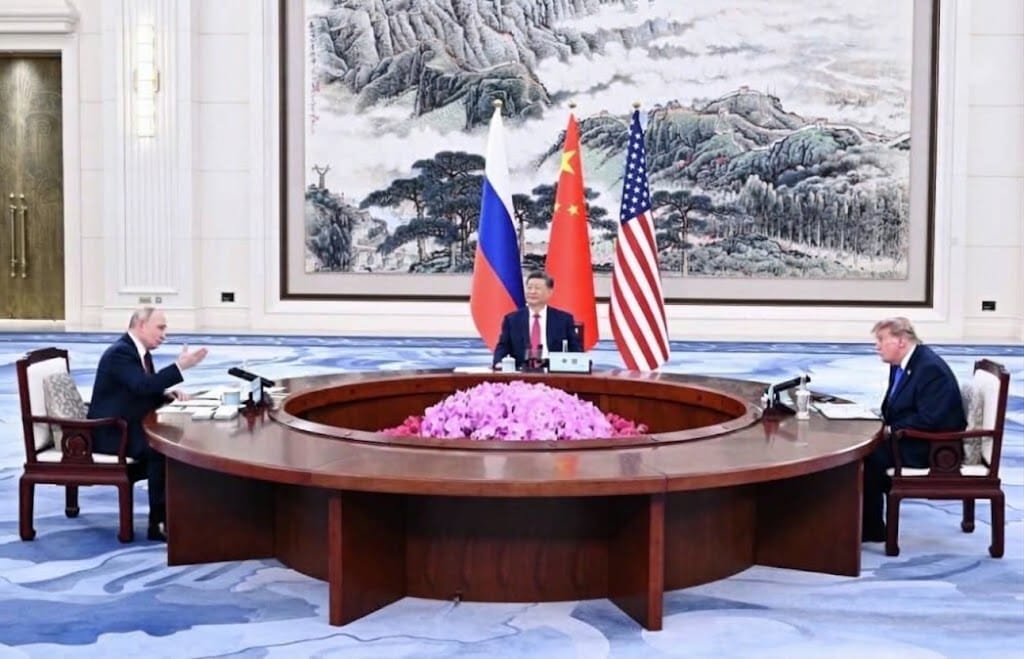
Bold analogies, especially historical ones, are by no means an invention of modern propaganda; they have long been a convenient and reliable way to frame a narrative. Napoleon was compared to Charlemagne, Moscow to the Third Rome, and Kaiser Wilhelm II sent Germans to China, likening them to “Attila’s Huns.” We, in turn, have gone through this — for example, in our attempts to prove that civilians are also engaged in something no less important through the use of economic, cultural, diplomatic, informational, and other equally dangerous fronts. And just think how many “Ramsteins” we’ve had. Economic, energy, cultural, industrial… and so, ahead of the ARES summit in Shenzhen between Xi Jinping, Donald Trump, and Vladimir Putin, the Russians began spreading a new simulacrum through all available channels of communication — claiming that they were gathering for nothing less than a “second Yalta.” They were alluding to the Yalta Conference, where Churchill, Roosevelt, and Stalin met to agree on new rules for global coexistence. However, in the winter of 1945, the three negotiators — whose talks, it should be noted, concluded quite favorably for Stalin — met already knowing that they were winning the world war. This is precisely the essence of the Russian narrative: to cement in the minds of as many people as possible the idea that the victors of the current Russian-Ukrainian war (or Russia’s war against the EU and NATO, if one follows Russian narratives) have already been determined. The only person to ask a question at the trilateral meeting was the Russian Kolesnikov, and he asked: “Is this meeting like Yalta 2.0?” — specifically so that Putin would nod solemnly, and this immediately made it into the headline of “Kommersant” and other Russian news outlets. Knowing this, reading Western columns with headlines like “Ghost of Yalta Returns” is about as awkward as watching an interview with MP Kucherenko.
In short, the global information space had become sufficiently agitated that by Wednesday morning, it was reacting to any and every provocation, no matter how minor. Every second of video footage from Shenzhen — where Xi, Putin, or Trump appeared in groups of one and a half to three — was meticulously analyzed to determine who was there and in what capacity. Even before the talks began, no one had any particular doubts that the only politician for whom the three-way meeting would be 100 percent beneficial was Xi Jinping, who, as the host of the meeting, served as the chief orchestrator. With Putin, it was more complicated: many, noting that Xi personally greeted the American president at the gangway (something he doesn’t usually do), immediately took it as a sign that a “regular official” — one who was noticeably taller, “probably chosen for his height” — had been sent to meet Putin. This is a rash oversimplification: Cai Qi is considered the Chinese leader’s right-hand man; he personally manages Xi’s schedule and — especially after numerous purges within the administration and the military — is the person closest to him. And Trump himself not long ago greeted Xi at the aircraft steps when he arrived in the United States, so this is a symmetrical gesture in return; one shouldn’t read it as an unambiguous humiliation of Putin. China does not humiliate its junior partners.
The Strategic Briefcase
Since Russia’s GDP is not comparable to the economies of China and the United States — despite all of Trump’s efforts to undermine the latter — Putin is trying to visually match them in other ways. And right from the start, he’s showing off what appears to be a nuclear briefcase — the same one he flaunted on camera in China three years ago, that time in Beijing. This news is spreading through the world’s leading publications, even though it stems from a single video by a Russian propagandist. None of the publications that broke this story has any way of verifying what’s inside the briefcase: a nuclear launch button or a set of airtight bags for the Russian dictator’s excrement, as he has for years been wary of leaving it in other people’s toilets. All of this, just like Peskov’s ostentatious statement that there would be no one-on-one meeting between Putin and Trump (just a few hours before it took place), looks like an attempt to pad the narrative to suit Putin’s agenda. Above all, he was wary of coming to Shenzhen and realizing what Xi Jinping was demonstrating all too openly: his Kremlin ally hasn’t grown enough to sit at the trilateral table. In addition to the briefcase inadvertently shown on camera — for those not impressed by such crude Russian propaganda — two nuclear bombers that accompanied Putin on his trip are stationed in Vietnam.
Any other U.S. president who had set out to preserve what remains of the old world order — a structure that now feels little more functional than the Kerch Bridge after the recent explosions — might have used, in particular, these attacks on the bridge to put the Russian president in his place. Instead, U.S. Deputy Secretary of Defense for Policy Elbridge Colby could not have chosen a better time — just one day before the summit began — to criticize Ukraine’s long-range strikes on Russian territory — a criticism so absurd that the German defense minister had to come to Ukraine’s defense. Such a situation would have been utterly unimaginable just four years ago. Then again, back then, much of what exists in today’s reality would have been difficult for us to imagine.
The Taiwan Issue
The U.S. administration’s flirtation with an aggressor state allows Xi Jinping to achieve his main goal even before the trilateral meeting begins, without lifting a finger. The Chinese leader’s ambition is to bring the island of Taiwan back under the PRC’s control during his lifetime; since World War II (as well as during certain historical periods before it), Taiwan has lived a life entirely its own, cut off from the mainland. It is de facto independent and, moreover, the site of production for more than 90 percent of the world’s most advanced microchips (which are used in smartphones, computers, military equipment, and so on). I observed the most recent elections in Taiwan and saw with my own eyes how Chinese propaganda operates in the local capital, Taipei. Thanks to the democratic system of free speech — which the PRC itself lacks —TV channels and online media outlets funded by Chinese money are using the Ukrainian example (and regular military exercises in adjacent waters) to convince people that the large neighboring power must not be made into an enemy, because no one will protect them from it. Don’t believe me? Look at how the Americans are treating Ukraine.
Even before our era, Confucius’s contemporary, the Chinese strategist Sun Tzu, strongly advocated against waging war where propaganda could suffice. In 2024, Taiwan’s Democratic Party lost its effective majority in parliament but won the presidential election. A year and a half later, in early 2028, it risks losing the presidential election as well. And then Taiwan will begin a political rapprochement with China without a single shot being fired. That is what Xi Jinping wants, but he is also considering another scenario — and the purges in the military speak to this quite eloquently. He will have little time for this alternative scenario: from January 2028, when the election results on the island are announced, until January 2029, when a new occupant moves into the White House. By then, Donald Trump — who has been doing a fine job of facilitating China’s strategy of peaceful intimidation against Taiwan with his statements that the U.S. will not come to the island’s aid (even though the relevant law was passed by Congress at the time) — may be replaced by a U.S. president who is slightly less chaotic and more aware of the consequences of his actions.
A Three-Pronged Demonstration
So, Putin flew to Shenzhen with an impossible task: to convince the international community that he is no less significant than Trump and Xi. The Chinese leader allows his guests to project precisely the image that serves his own political agenda. A natural question arises: what is Trump doing in this company? He has just suffered a crushing defeat in the congressional elections and needs to show voters at least some kind of victory. Quickly. Something impressive. Like a deal. But with Iran — the only country with which half the world is anxiously awaiting an American deal (while fuel prices continue to rise) — it won’t be possible to quickly reach an agreement on his terms. Ukraine, too, has not yet shown much willingness to capitulate on Russia’s terms, but why not give it a try? Trump’s favorite negotiators, Witkoff and Kushner, continue to convince their boss that this is easier than Iran and, most importantly, offers greater personal gain. There is another potential selling point to tout at home: nuclear disarmament. However, while Moscow shows a willingness to play along with Washington on this, Beijing is categorically opposed (since it still has far fewer warheads than Russia or the United States, although it is rapidly increasing its stockpile), so nothing will come of it. Xi also has no intention of increasing China’s presence in any format of Russian-Ukrainian negotiations. China calls for peace only on its own terms, and there are simply too many players at the table here.
However, if all the world’s leading media outlets are calling your meeting “historic,” and then you yourself call it “historic” — then it surely is historic, and you’ve once again done something just as historic as the renovation of the White House (or the Reflecting Pool near the Lincoln Memorial, which, for the first time in history, turned green afterward). This trilateral meeting holds no more significance for America than the (also historic) handshake with Kim Jong-un at the 38th parallel — the very border that, following a war for which no peace treaty has yet been signed, divided Korea into North and South. For Donald Trump, just as for Vladimir Putin and Xi Jinping, the main point of this meeting is a striking media image designed to reinforce narratives that serve his interests. When Putin speaks at the meeting about “the joint contribution of our three states to strengthening peace and stability through cooperation based on mutual respect and a balance of interests,” he is primarily referring to the ability of the three aforementioned states to control the rest, should they so desire. This is not true, yet many small pro-Russian lackeys in the global media are already beginning to spin this falsehood.
Nuclear Weapons, Oil Products, and the Resuscitation of the UN
At the start of the trilateral meeting, Xi Jinping declares: nuclear weapons must be completely eliminated. This is just as much a rhetorical exercise as Putin’s statements about world peace; the Chinese leader repeats almost word for word what he said in Geneva in 2017. Given China’s smaller nuclear arsenal and the full realization that in the real world — where international law has been undermined by Russian aggression — no one will give up their nuclear weapons, Xi can afford to use the most anti-nuclear rhetoric possible. After all, he is facing two other states that have no intention of disarming first.
The context for this round of talks on nuclear deterrence — which ended up right back where they started — is a rumor spread a couple of days before the U.S. election by Trump’s former ally Tucker Carlson: that the U.S. president was seriously considering the possibility of a tactical nuclear strike against Iran. Trump himself later appeared to refute this with a general statement that new strikes against Iran were unlikely; however, around the same time his plane was approaching Shenzhen, Axios shared new rumors citing “two informed sources.”
In the “declaration of peace” issued following the trilateral meeting — in which they agreed to agree on world peace — this was exactly what one should have expected from the meeting. At the same time, all three countries put in writing a plan to increase the production and sale of petroleum products “for the benefit of all nations,” and this is perhaps the only truly unpleasant news coming out of Shenzhen, signaling Trump’s plans to continue lifting sanctions on Russian oil. Against this backdrop, the condemnation in the text of the declaration by the International Criminal Court — which recognized Putin as a war criminal and issued an arrest warrant for him — seems like an unnecessary afterthought.