ENG

(Intro by Tom Cooper)
Hello everybody!
Except for the African Horn, the other affair I’m tracking the last few days is the Ukrainian counteroffensive launched sometimes between the last weekend (7-8 February) and Tuesday.
Arguably, the exact extension of the same remains unclear. However, Glavcom Syrsky’s ‘handwriting’ is obvious alone from there being no focus on one area, but this operation consisting of efforts scattered over several sectors. Correspondingly, counterattacks were registered in the Svyatohirsk, Borova, Pokrovsk and Hulaypole sectors. Because: why follow advice provided already for years, and focus all attention, all UAVs, all artillery, all forces, all supplies and all the air defences on one sector, so to increase the moment of surprise and the firepower of the involved forces?
That could result in a durable success… which, apparently, nobody in Kyiv wants: the ‘liberation’ of ‘numerous’ ruined hamlets with pre-war population of 5-16 is far more important. That’s expanding the list of successes, you know…
Another issue is that of what has Ukraine really ‘liberated’: many doubt it was anything at all. Some are insistent that the liberated villages were never controlled by Russia: that these were places within the ‘grey zone’ with presence of only small assault groups….
Finally, it’s not like if the Russians have ceased their offensive operations everywhere: indeed, in some sectors they have continued their grinding forward (call it ‘advance’, if you like).
Ah well… before you start accusing me again that I can’t but bash the Zele/Syrsky combo all the time, no matter what they do, better I hand over to Don.
Russia’s loss of Starlink satellite communications and some weather conditions reduced the intensity of Russian drone and ground operations. Throughout the winter, attacks averaged between 180-200 a day and sometimes reached 230-250 a day. Last week the daily number of assaults was in the 124-160 range. There have been Ukrainian counterattacks against Russian positions in the gray zone and beyond, and some Ukrainian vehicles were lost in offensive operations.
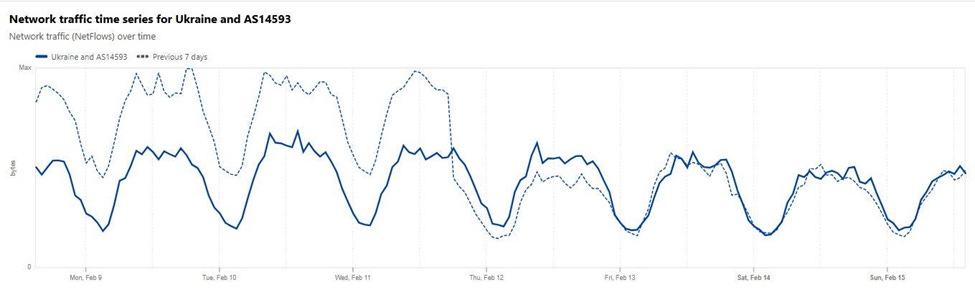
The network traffic dropped when unregistered Russian and Ukrainian Starlink terminals were blocked. Ukrainian Starlink terminals are still being registered.
Sumy
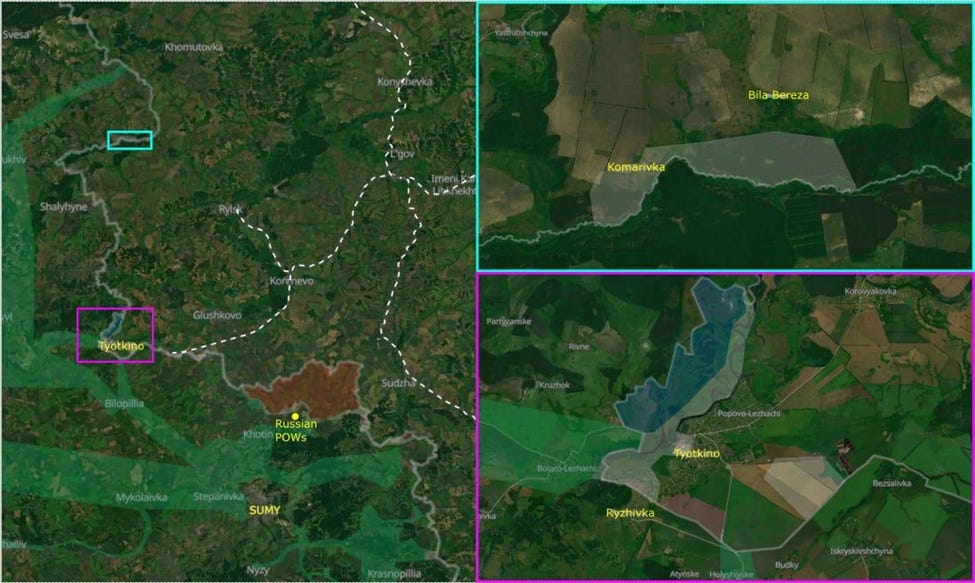
Russia’s 22nd Rifle Regiment was tasked with advancing out of Tyotkino to take Ryzhivka and the surrounding territory. They suffered heavy casualties and the wounded were sent back into assaults. Ukraine conducted an airstrike in Tyotkino.
Strategic Missile Forces troops were formed into infantry units over a year ago and have been used in attacks on Bila Bereza, 50 km north of Tyotkino.
Ukraine captured several Russian prisoners.
North Korea sent about 14,000 troops to Kursk. 3,000 returned to North Korea to pass on their knowledge. They are still firing artillery and rockets into Sumy and conducting reconnaissance.
Kupiansk
The 14th Mechanized Brigade destroys 2 MTLBs, 2 quadbikes, kills 17 Russians and wounds 4 more in Podoly. Russian infiltration attempts in the Radkivka and Myrove area continue.
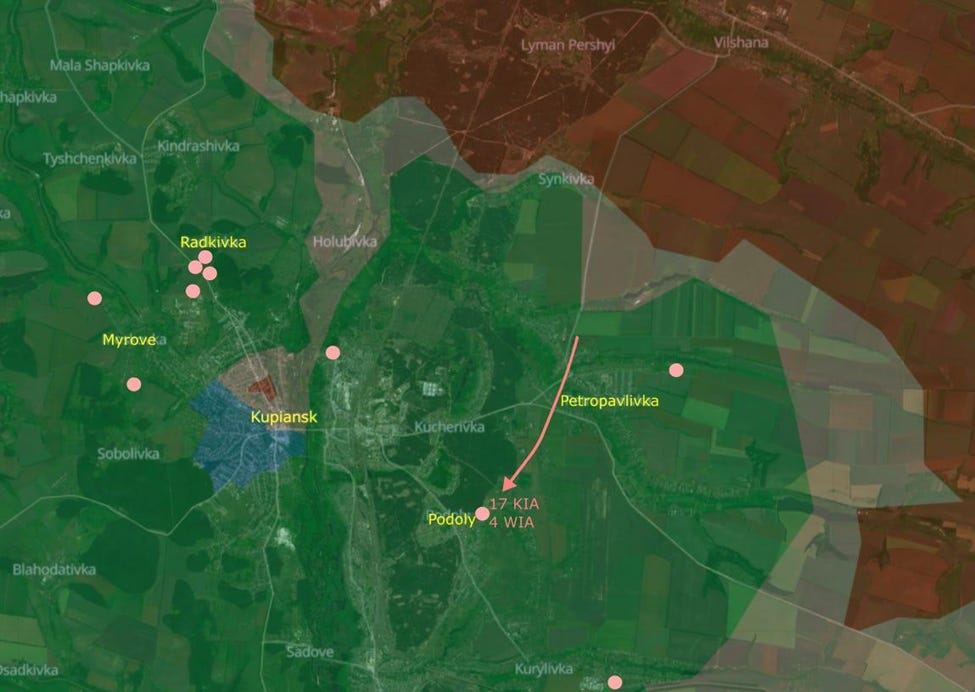
Inside Kupiansk, the Ukrainians have cleared the Russians from the School No. 1, thus finally cutting off the Russians still holding out in the Central Hospital. But, the Russians continue resupplying by drones. However, as soon as this operation was concluded, Syrsky ordered the withdrawal of his own 475th Assault Regiment…
Svyatohirsk
The last week, this area saw one of ‘major’ Ukrainian counterattacks. Supported by artillery and lots of drones, the ZSU counterattacked into the flanks of the Russian advance on Svyatohirsk. In the north they advanced from Korovii Yar for about two kilometres down the road to Shandryholove. In the south, they pushed across the Nitrius River - also in direction of Shandryholove - and have managed to re-enter Novoselivka. The Russians, however, seem not to mind the loss or few treelines, nor the southern side of Novoselivka: indeed, they are continuing their push on Svyatohirsk.
For all practical purposes, this is actually a classic ‘local counterattack into the flanks of an enemy advance’. Just run in style of this war as of 2026: with lots of drones and rather slow advance of ground forces. Not in form of ‘major movement of mechanised forces’: this is impossible because of enemy FPVs and mines.
Sloviansk
The closer Russia comes to Kramatorsk (15 km) and Sloviansk (20 km), the quicker they will be destroyed. It is the Russian peace.
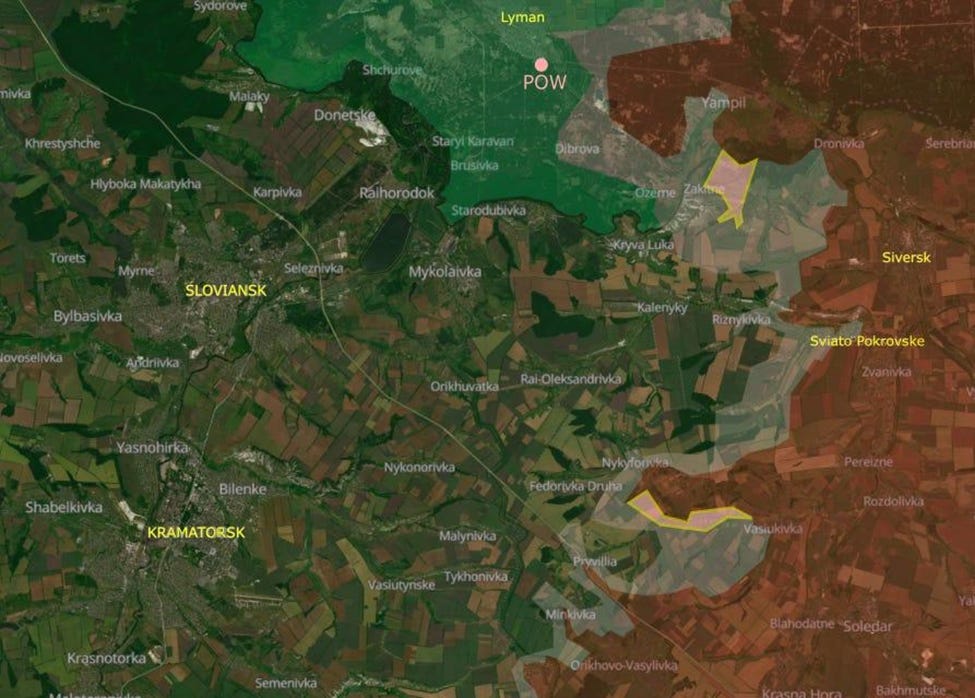
A Russian prisoner is taken on the eastern edge of Lyman.
Kostiantynivka
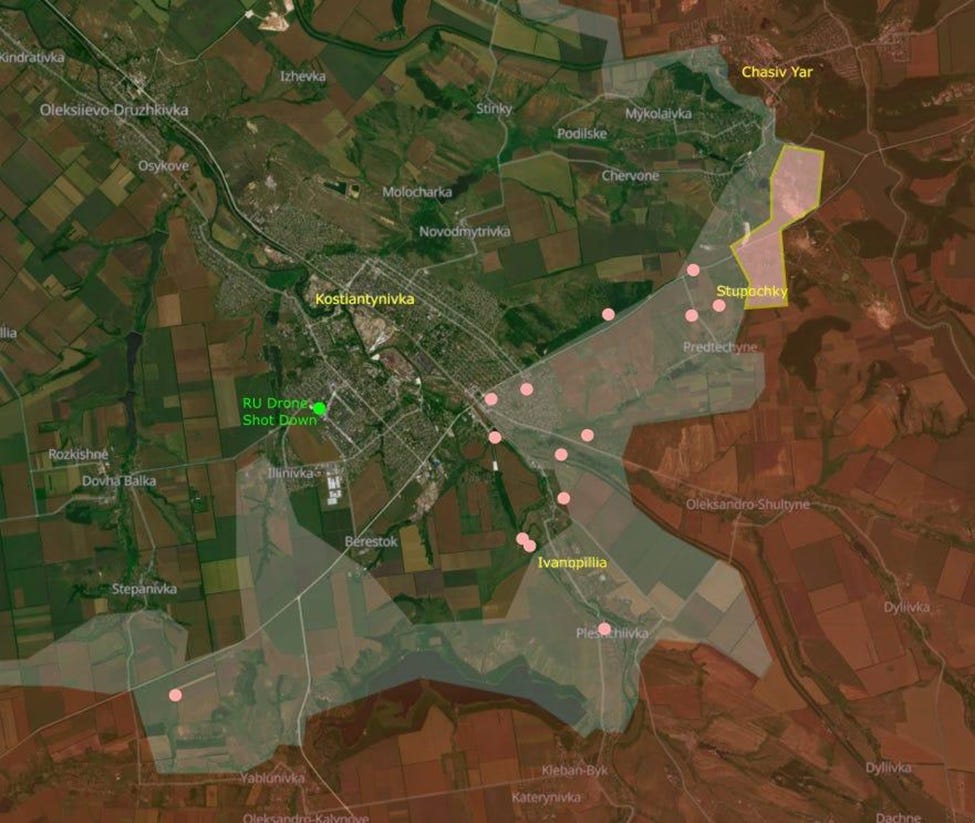
This was the second sector to see Ukrainian counterattacks, the last week. The ZSU pushed from the area south of Mykolaivka in direction of southern Chasiv Yar (which, if you might have missed this part, is completely under the Russian control for months already). The Ukrainians have reached the ruined substation and the wastewater treatment plant, then turned north and punched into the Shevchenko District, before infiltrating towards the city centre. That’s where this advance came to an end, though: the ZSU did not manage to secure any of positions inside Chasiv Yar.
After 20 rounds, a Ukrainian soldier shoots down a Russian drone.
The 28th Brigade was finally able to rotate some soldiers out of their positions after 137 days. They had been there since September. Drones, artillery and remote mining interfere with logistical support. This operation to rotate three soldiers took a week and involved droners and mobile fire groups that specialize in shooting down drones. They walked during the day when there were fewer drones flying, and they shot down drones that were looking for targets. A Ukrainian drone commander said a drone target is more likely to survive by trying to shoot a drone down than run away.
While it is not common, there have been several instances of infantry shooting down drones. In the Huliaipole sector, the 225th Regiment sent six drones to attack a Russian soldier. He shot some of them down and some detonated in the trees he used for cover. So they fired an artillery round, but it missed. They expended six more drones that finally wounded and then killed him. That’s a total of 12 drones and one artillery shell to kill one Russian soldier.
Waiting For Impact
In January 2023, Russia started outfitting their FAB-500 dumb bombs with UMPK wing kits that allowed them to glide for 70 km guided by GLONASS satellite navigation that theoretically allowed them to hit within 10 meters of the target. In the spring of 2024, Russia started deploying the UMPB bomb that had integrated wings instead of a strap-on kit and the better aerodynamic form allowed it to glide 90 km. UMPB-5 models have a rocket motor that provides it with a range of 200 km, while a version without the rocket can glide 150 km.
These bombs played a significant role in Russia’s ability to advance in 2023 and 2024. and by 2025 Russia was launching 3,500 bombs a month. In March 2025, Ukraine deployed the Lima EW system that interferes with the navigation of these bombs. The loss of accuracy greatly reduced the risk to Ukrainian positions but did not eliminate the threat. Russia started using more bombs to attack the same target in the hopes that one of them would land close enough to damage or destroy the target. And while a bomb that missed a Ukrainian defensive position might land in a field, a bomb that missed the target in the city will likely just hit another building in the city.
For every move in electronic warfare, there is a counter move. There are reports that the UMPB-5 might be more resistant to EW jamming. Time will tell if that is true and if Ukraine will be able to counter Russia’s EW counter.
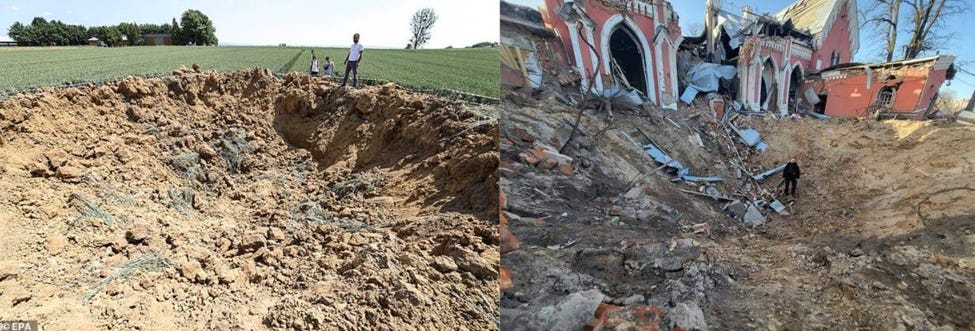
Even a near-miss with a 500 kg bomb can be deadly.
In any case, the UMPK bombs remain a factor, whether through volume or increasing accuracy, as this report from the Azov brigade shows. A drone team is two meters underground in a bunker. Earlier in the day they hit 23 targets. A Russian drone likely detected some of their activity and relayed the coordinates to their chain of command.
About 10 minutes ago, the radio said “You have SU-34s in the sector, wait for the KABs”.
It’s three in the morning and we’re trying to rest. Rest, not sleep. At the zero line, you don’t sleep, you just rest when you have the opportunity. Short, intermittent naps, in a chair, on a wooden bench. Always fully dressed and ready for the voice on the radio that means the next action.
“Three KABs in your direction,” a calm voice came from the radio three minutes ago. As if it were announcing the weather forecast. There’s no hiding from a KAB and there’s no point in running. When it falls, even an underground bunker within a few dozen meters won’t help you. The crater itself from a 500-kilogram bomb can be ten or more meters wide. However, the zone of the deadly blast wave is much larger. And there’s no point in running, because you don’t know where it will fall. Not even the pilot who dropped it from a safe distance knows exactly.
“Kivi, Pirate. One minute to impact,” comes the radio. Janka snuggles closer to me and I start counting down the seconds in my mind. I firmly believe, I hope, that these are not the last seconds of our lives. Three KAB glide bombs are flying at us.
... 59, 58 ... we are two meters underground. In the bunker (”bulletproof”) of the drone assault unit of the 12th AZOV brigade somewhere near Kostyantynivka. Two meters underground, in no man’s land. In a zone controlled by drones - ours and Russians. In the death zone. It is about 10 kilometers to our rear and a little less to the Russian positions.
... 41, 40 ... we have had a difficult day. In the morning it was relatively calm, but then the Russians started to attack (”storm”) our position. Mavic reconnaissance drones spotted two BMP-2 armored infantry vehicles, each with 10 aggressors and 3 motorbikes moving towards us. That is quite a large force by today’s standards, when two, or a maximum of three-man squads normally assault. We have two positions here, four guys with small arms in each. We would have no chance against armored vehicles with a 30mm automatic cannon.
... 30, 29… The multi-role bomber is the most common carrier of glide bombs. It usually carries 2-4 bombs weighing 500kg. It drops them from heights of around 8 to 12 kilometers. At this level, it flies out of reach of most air defense systems. After dropping the bomb, it unfolds its wings and begins to glide towards the target. From a height of approximately 10 kilometers, it can fly 40 to 70 kilometers. The flight lasts several minutes - typically three to five.
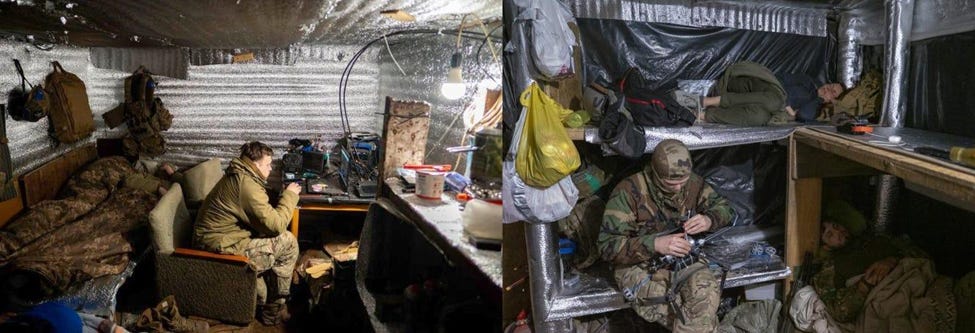
A drone team waits underground to find out where Russian bombs will land.
... 22, 21 ... it is really difficult to hit a specific cellar with a KAB. But when the Russians are sure that there are drones in a given place, they do not hesitate to “invest” even 10-15 bombs at a price of approximately 30 thousand euros each. This happened to our friends from the Makhno unit. When the Russians discovered their position near Hulaypole, they showered them with KABs. None of the 9 guys survived the fifteen-hour raid. Only four were identified.
...10, 9 ... KABs are “aircraft artillery” for the Russians. Just as in 1994-95 and then in 1999-2000 Russian artillery shelled the Chechen city of Grozny for months, now they are terrorizing Ukrainian cities with glide bombs. Bakhmut, Torets, Chasiv Yar, Maryinka, and now Pokrovsk and Kostyantynivka - these are “monuments” of the spread of Russian “peace”.
I remember how volunteer Larisa once described her feelings to me when she first came under fire. “Maybe it won’t hit me. And if it does, maybe I’ll just lose my legs. Or one. That would be fine. I’m an accountant, I need my hands to work. And what if they take my hand off? My left. I can do the job with my right. That would be fine... or... it would be better if it didn’t hit me today.” Exactly. It won’t hit us today. Not today.
... 4, 3 ... a powerful explosion throws us onto a wooden bed. We are upstairs and earth is falling from the ceiling on our heads. “That was close,” Jana whispers. “Yes, but still...” another explosion drowns me out. I hold my breath ... the third explosion is a little weaker. I breathe out deeply. I am not alone ...
“Kivi, Pirate. Everything okay? Where did it fall?” comes the radio. “A little next door ...” replies the voice from the Pirate position. No one here even bothers to get up to listen to the radio.
You can’t hide from KAB. You can’t run away. You can’t shoot it down with a handgun. The only thing you can do is prepare before it comes. Have your own eyes in the sky. Your own drones. Your own operators.
Every Mavic means fewer Russian drones over our heads. Fewer coordinates given to bombers. Fewer bombs.
Three KABs fell short today. They may not tomorrow.
This text is published with the permission of the author. First published here.


.jpeg)