ENG

Recently, while reporting on a conflict within the Assembly of Crimean Organizations, I had to spend a considerable amount of time speaking with both sides. Many Crimean Tatar political forces were drawn into the conflict.
In the run-up to May 18, a struggle erupted over control of the rallies in European cities.
The two main issues for the competing Crimean Tatar groups were whose banners would be displayed on the day of mourning and who would control the microphone at the rally…
And it doesn’t matter that sometimes only a few people gather at such rallies, and the number of local participants — Poles, Germans, or Belgians — often approaches zero.
In one such conversation in early May, I suggested to a young leader with great ambitions that he stop competing over the number of rallies and reconsider his approach to May 18.
Nostalgia for rallies of many thousands in Crimea resembles the longing of old men for their former virility. It will never be that way again. At least not anytime soon in Crimea, and never in Europe.
The largest rally commemorating the deportation — which began with a march of thousands of people from across the peninsula to Aqmescit and drew 50,000 people to Lenin Square — took place in 1999 and is unlikely to be repeated.
Rallies are banned in Crimea — there, people have been searching for new ways to preserve the memory of the genocide for 10 years now.
Those who left continue to feel nostalgic for the lit candles and the chance to hold a microphone in front of thousands of listeners.
On the Ukrainian mainland, rallies as a form of mourning have been unsuccessful events since 2015.
There were few Crimean Tatars in Kyiv (and only a negligible fraction actually attended the rallies), and for most Ukrainians, the date has not yet become part of their shared grief. Credit must be given to the state — it was the Ukrainian authorities who were able to propose and fund new forms of commemoration: requiems at the National Opera and the unveiling of a memorial visited by the President of Ukraine.
In Europe, there will be neither rallies like those in Crimea nor the forms of commemoration that Ukraine has created.
Therefore, to gradually engage Europeans, we need to find a way to their hearts — a form that will resonate with them through their own values.
When we began to reflect on classic global examples of how ideas spread, successful religious initiatives came to mind: The Holy Fire (even if it’s lit by monks of the Church of Jerusalem with cheap lighters) and the Camino de Santiago de Compostela (the pilgrimage along St. James’s route, similar to a hiking marathon, but among Catholics).
How can we connect Crimea and Europe so that May 18 takes on new life? How can we avoid turning it into a “celebration” of the deportation, on the one hand, while also ensuring it isn’t marginalized due to the tiny size of the Crimean Tatar diaspora, on the other?
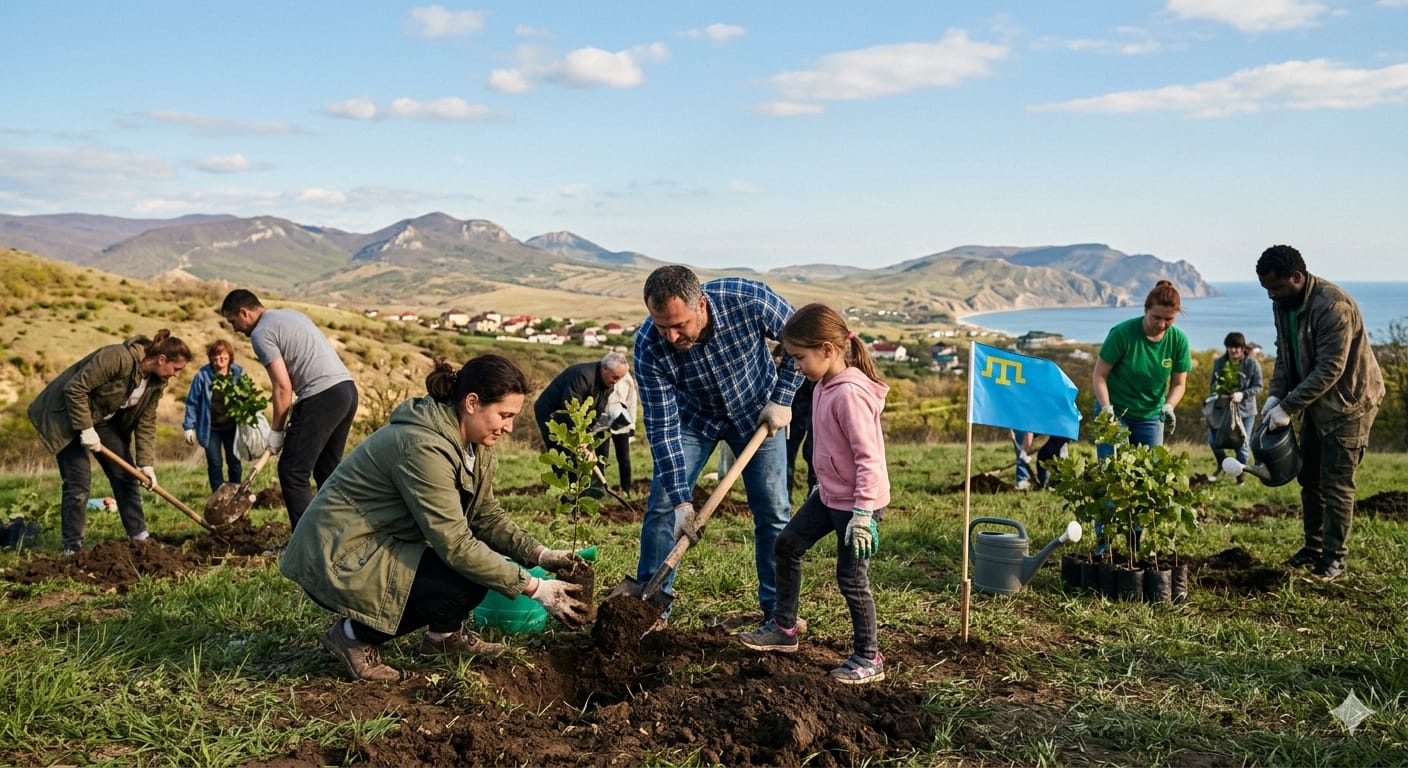
For example, every May 18, we could bring a handful of soil from Crimea and plant saplings native to that region in it, in memory of those deported from Crimea. Bringing saplings from Crimea every year would be a beautiful gesture, but phytosanitary regulations would not allow it, and under the current occupation, no one will bother with these formalities. However, a symbolic handful of Crimean soil, scattered in a new location, could become the symbol that connects May 18 with a European city. If we take this idea seriously, over time, Crimean squares and parks will appear in many cities…
I shared this idea with several participants in the conflict at the Assembly of Crimean Organizations, and it turned out that it is possible to be heard even without direct dialogue. One of the imams in Kyiv (who, incidentally, had spoken out against Qıdırlez) publicly voiced the idea of planting trees instead of lighting candles and laying flowers. And some Crimean Tatar politicians even managed to mark the recent anniversary of the deportation by planting a tree.
If we rethink the Way of St. James, we can find Crimean Squares in several European cities that could serve as the finish line for a marathon or bike ride. They are named in honor of the Crimean War of 1853–1856. For Crimean Tatars, this war has not yet become a key date in the collective consciousness. For Europeans, it marks the victory of the coalition of France, England, the Ottomans, and Sardinia over Russia. That victory — and the subsequent betrayal by the Europeans — led to the mass expulsion of Crimeans from the peninsula. It was then, 80 years after the annexation of the Crimean State, that its indigenous people became a minority in their own land.
There is no need to invent an additional day of mourning for this. Alongside May 18, we should promote June 26 as Crimean Tatar Flag Day. A bicycle race or mass run leading up to this day could also become a notable European event. All the more so because Spain is home to the renowned cyclist Jamoliddin Abdulzhaparov, who has won all the world’s major cycling races in the sprint categories, and the Netherlands is home to Marlen Zmorka, a talented Ukrainian cyclist who retired early from competition to become a coach. I am confident they would be happy to get involved in organizing such an event.
And the most important significance for the Crimean Tatars, as an indigenous people of Ukraine, would be the creation of a joint commemorative day or holiday with the Ukrainians — a day that would unite the two peoples — the Crimean Tatars and the Ukrainians — into a single political nation.
Over the past month, several public figures in Ukrainian society have voiced this idea. Among them are philosopher Valery Pekar and one of the country’s most experienced diplomats, Sergey Korsunsky. On June 3 (May 24 according to the old calendar) 1571, Crimean Khan Devlet Giray I burned Moscow to the ground. Today, Ukrainians desperately need to replicate that Crimean Tatar victory. And perhaps voluntarily agreeing to adopt this date will reduce the number of mutual grievances surrounding “chebureks with pork” and arguments over who betrayed whom during the time of Bohdan Khmelnytsky or during the second annexation of Crimea in 2014.


.jpeg)
