ENG

Elvira Kemal is a researcher of Crimean Tatar history who lives in Germany. We are publishing her new article for the Turkish publication "Yenidevir".
After the annexation of the Crimean Khanate, Russia exempted the Crimean Tatars (as well as many other conquered Muslim peoples) from regular military service — to avoid potential acts of sabotage. But, as is often the case, there were quite a few among the people who continued to pursue military careers. This was especially true since the former nobility of the Crimean Khanate was granted equal rights with the nobility of the Russian Empire and received all the associated privileges.
One such person was Kaya-bey Balatukov, the first Crimean Tatar to become a general in the Russian Empire. The Balatukov family was of Circassian descent; Kaya-Bey’s father, Memet, served as minister of finance during the first reign of Khan Qırım Geray.
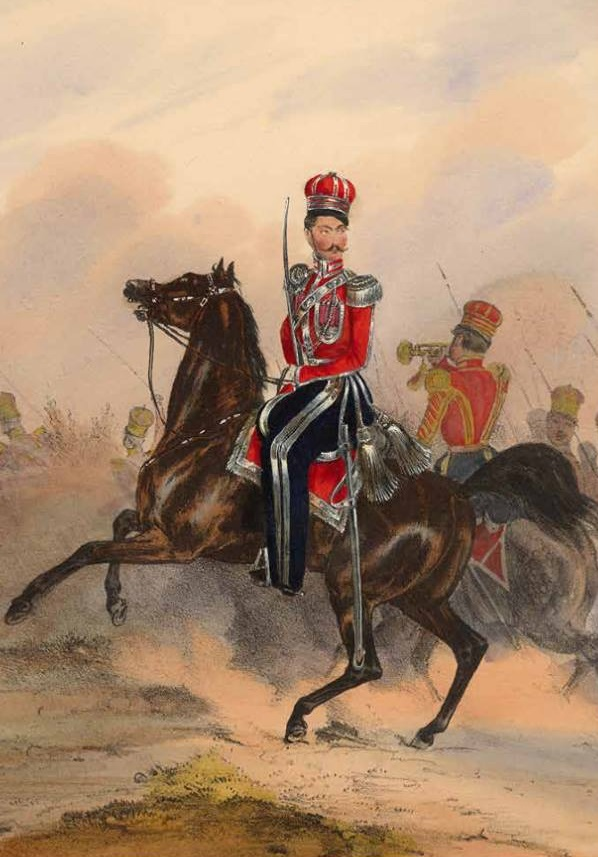
Commander of the Simferopol Tatar Cavalry Regiment, Colonel, Prince Kaya-Bey Balatukov
Kaya-Bey began his service in the Greek Corps and later served in the Russian army under the name Kirill Matveyevich Balatukov. He also led the newly formed Simferopol Tatar Cavalry Regiment.
Crimean Tatar cavalry divisions had existed before — they were formed by order of Catherine II. They were immediately sent to the borders of the Polish-Lithuanian Commonwealth during the Second and Third Partitions of Poland. Even then, the Crimean Tatars had to face their co-religionists, the Polish Tatars, in battle. But the empire was not particularly concerned about this. Immediately after the end of active hostilities, the divisions were disbanded. The same thing happened during the Russo-French War: as soon as the fighting ended, the Crimean Tatar military regiment was disbanded. However, Kaya-bey Balatukov personally negotiated with Tsar Alexander I to establish the Crimean Tatar Life Guard Squadron. It was this very squadron that took part in the siege of Varna during the Russo-Turkish War, though it was commanded by Kaya-bey’s brother, Adil-bey Balatukov.
During the Crimean War of 1853–1856, a detachment of that same squadron — under the command of Balatukov’s nephew, Omer-bey — fought in the Battle of the Black River. On the Fedukhin Heights, the Life Guard Crimean Tatar Squadron attacked a British dragoon detachment and took it prisoner.
Nicholas I later wrote to Prince Menshikov: “I am glad that the Guard Tatars had the opportunity to prove themselves, and you did well to reward them.”
The history of the Balatukovs shows that the Crimean Tatar nobility found its place in the new system — receiving ranks, the trust of the crown, and real privileges. But the fate of a few general’s families did not reflect the situation of the entire people: for most Crimean Tatars, relations with the empire took a different form — marked by requisitions, suspicion, and restrictions, rather than orders of merit. This duality became particularly evident during the Crimean War.
Many Crimean Tatars opposed the war with the Ottoman Empire. And society was radically divided during the Crimean War. Some of the beys, mullahs, and murzas, especially in Yevpatoria and Yalta, openly sided with the Anglo-French alliance. There were instances of deportation of Crimean Tatars who supported their Ottoman brothers.
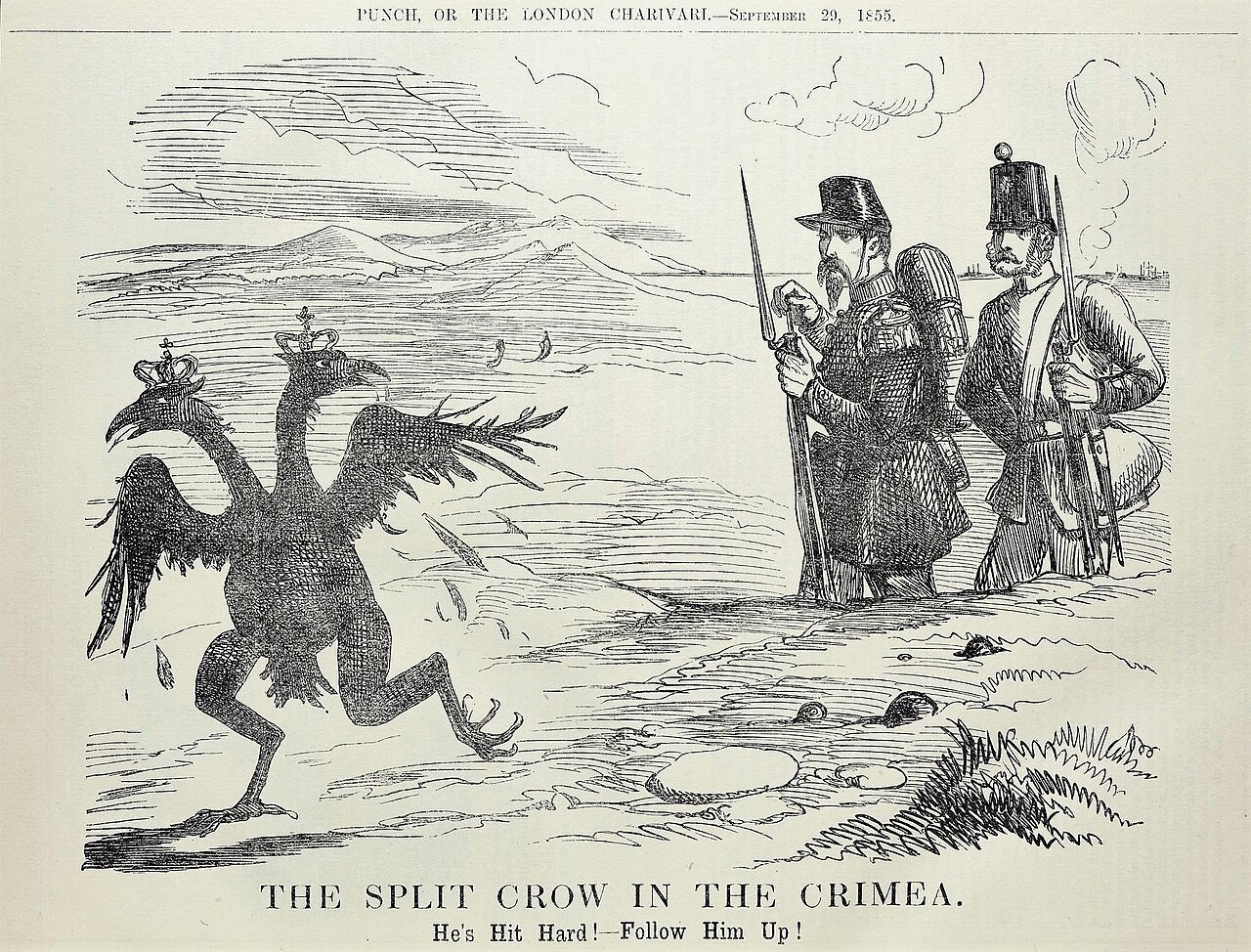
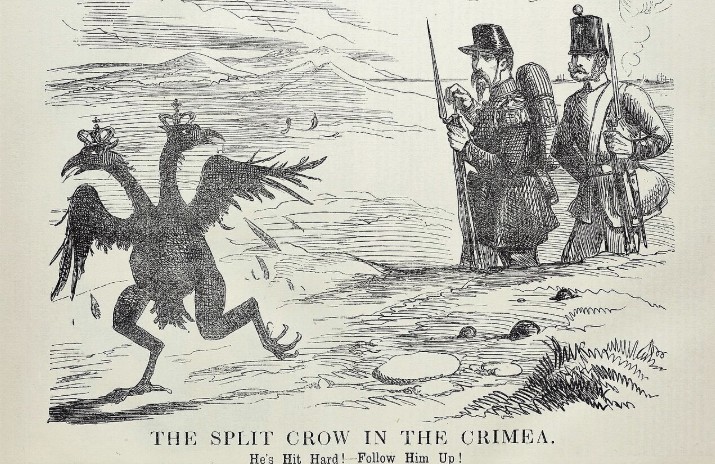
The Two-Headed (literally ‘Split’) Crow in Crimea,” a caricature in the London magazine *Punch*, September 29, 1855. French and British soldiers watch a two-headed eagle fleeing. Caption beneath the drawing: “The Two-Headed Crow in Crimea. It has been dealt a severe blow! Catch it!”
Nikolai Adlerberg, the civilian governor of the Taurida Governorate, pursued an extremely anti-Tatar policy. He believed that all Crimean Tatars from the coastal areas should be deported. On his orders, surveillance was set up, and searches and arrests were carried out — including of minors. This official treated the indigenous population so cruelly that complaints about him reached the tsar. Ferdinand Wrangel also insisted on the deportation of the Crimean Tatars. And they could not have cared less about the Crimean Tatar Army, which served the Russian Empire. To be fair, it should be noted that there were also Russian officials who defended the Crimean Tatars.
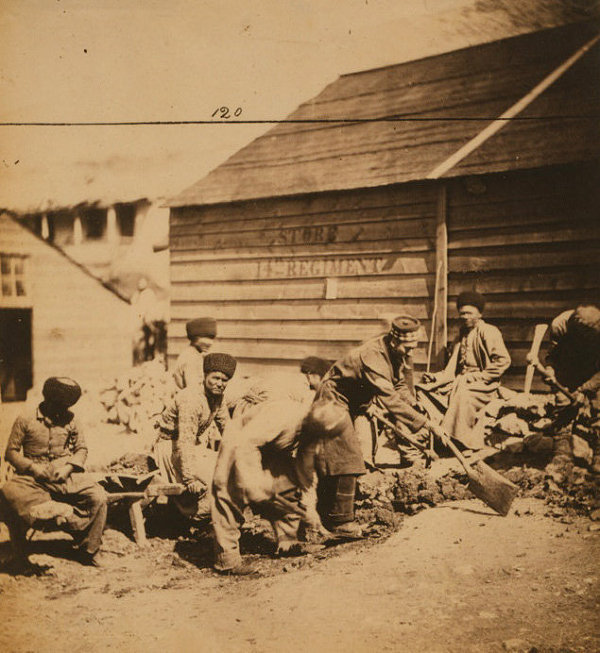
Crimean Tatars during the Crimean War, 1855. Photo from the U.S. Library of Congress, by Roger Fenton. A group of Crimean Tatars is working on road repairs in Balaklava; in the background is a wooden structure with the inscription “Depot of the 14th Regiment.”
On the one hand, the Russian authorities viewed the Crimean Tatars with suspicion and discriminated against them. On the other hand, the Allies sought to capitalize on the Gerays’ popularity among the local population. Thus, Mesud Geray, a descendant of the khanate dynasty, reappeared in Crimea; he rallied the people in the name of the Ottoman Empire’s victory and the restoration of the khanate, urging them to rise up against Russia and support the intervention. And it worked: the Crimean Tatars, trusting their new “leader,” supplied the allies with horses and wagons, launched an uprising, and even took some Russian officials hostage. But as soon as Mesud Geray was no longer needed by the allies, he was sent back to his previous post in the Balkans. It is important to emphasize that the Ottomans themselves did not use the Gerays for such self-serving purposes. Later, the French awarded Mesud Geray a medal for his diligence. How many Crimean Tatars had to die or be exiled along with their families for the sake of this award remains unknown.
The Crimean War clearly demonstrated that both sides of the conflict viewed the Crimean Tatars primarily as a resource. The Russian Empire used them as soldiers and a labor force, but paid for this with suspicion, surveillance, and threats of deportation — the same logic of distrust toward an entire people would repeat itself time and again, right up to the tragedy of 1944. The Allies, for their part, played the “Heroes” card just as cynically: the belief in the promise of the khanate’s revival cost people their property, their homeland, and, for some, even their lives.