ENG

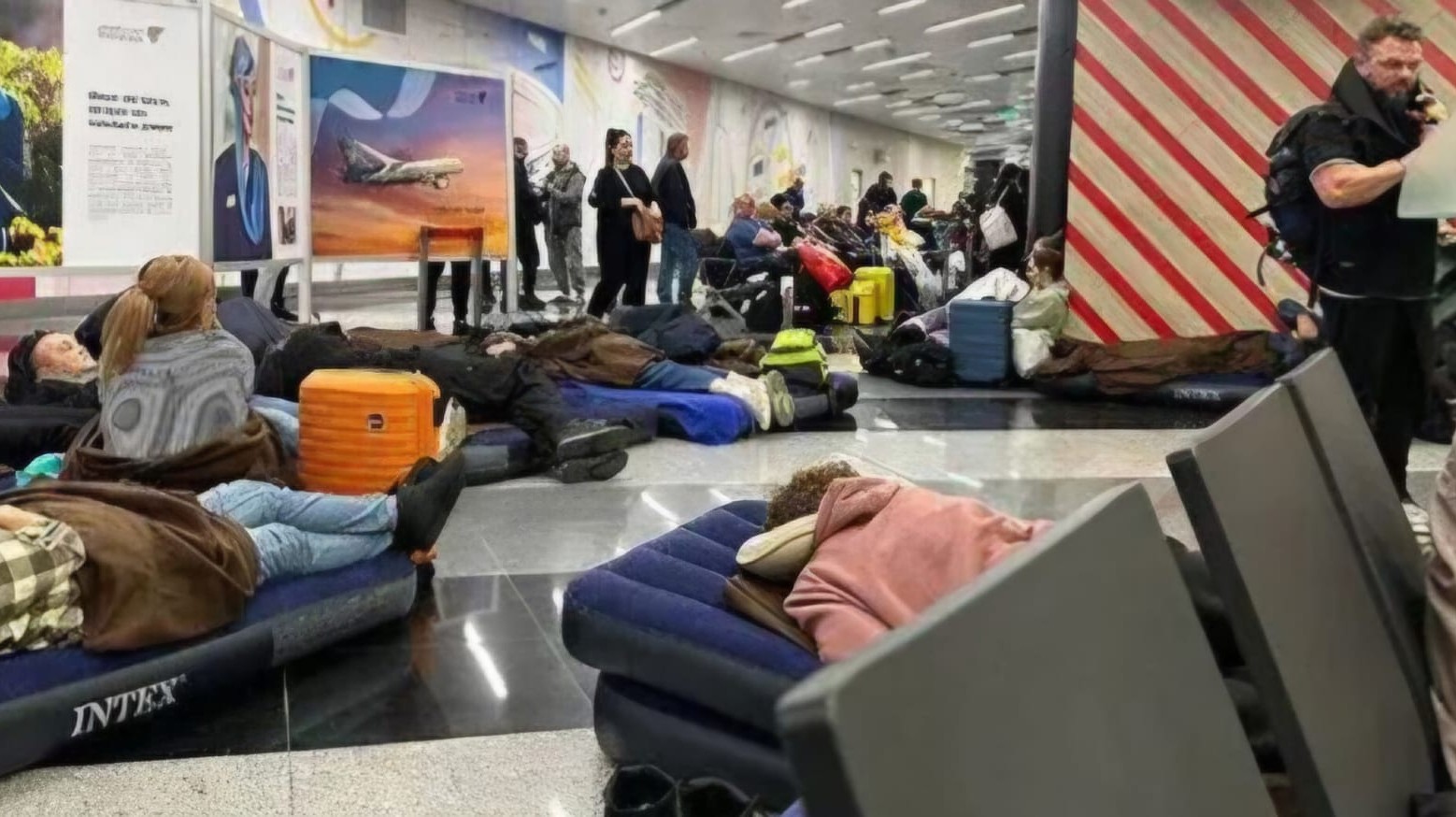
This has already happened twice this week, and now it will most likely become the norm. Russian security forces carried out their first roundup of residents of the occupied Ukrainian territories at Krasnodar Airport on October 21. At passport control, the documents of sixty passengers on international flights were confiscated, and the passengers were sent for “additional screening” without any explanation. All of them were registered in Crimea or the occupied regions of the Luhansk and Donetsk oblasts. For over ten hours, the people were held in a separate, locked room without food or water and were called in one by one for “talks.”
On October 27, the same thing happened again. Passengers with Crimean residency who had flown into Krasnodar from abroad were “turned back” at passport control.
“All Crimeans, without exception, were sent for screening. They weren’t just questioned; officials meticulously recorded all their details, including information about family members. They recorded information about their actual place of residence, place of work, education, whether they had relatives in Ukraine, phone numbers, social media profiles, which messaging apps they used, which countries they had visited before the annexation, mobile phone details, and many other questions — all answers were meticulously entered into a database on a security service officer’s laptop. At the end, they demanded that the person sign a consent form to undergo a polygraph test in case the verification of the provided data revealed any discrepancies. Then they photographed the person holding this consent form,” one of the Crimean human rights defenders told the “Crimea.Realities” project on condition of anonymity.
The human rights initiative Irade states that, at least until last year, Crimea itself served as a “filtration” site. People arriving on the peninsula from the newly occupied territories were sent for this humiliating “additional screening.”
“The procedures there were similar — interrogation, inspection of phones and social media accounts. At the Armiansk checkpoint and Chongar, they were also forced to undress for a search for tattoos,” the human rights activists explain.
They attribute the “Armiansk court anomaly” — where, despite the town’s small population, it ranked among the highest in the number of cases involving “discrediting the Russian army” — to this filtration process. Simply put, all residents of the Kherson region whose phones contained even the slightest mention of Ukraine were immediately sent to prison upon passing through the checkpoint. Now, Crimeans have also been added to the list of potential “unreliable” individuals. Human rights activists are convinced that this is just the beginning in Krasnodar, as it is the closest operational airport to Crimea. Soon, screening of residents from the occupied Ukrainian territories will be conducted at all Russian border checkpoints.
The goal of the security forces, say human rights activists, is to intensify repression. And the fact that a person holds Ukrainian citizenship significantly expands the possibilities for fabricating criminal cases. A Ukrainian banking app on a phone, or stamps in a Ukrainian passport indicating stays in Ukraine or visits to “unfriendly” countries, provide FSB officers with an excellent pretext to earn new stars for yet another “thwarting of a mythical infiltration by a Ukrainian agent.”
Not long ago, the Crimean Occupation Supreme Court sentenced Viktoria Sergeyeva, a resident of the Bakhchysarai district, to 15 years in prison, accusing her of treason. It all began at passport control, where it was discovered that Sergeyeva had spent several months in Ukraine. Next, they drew up a report accusing her of disobeying a border guard — allegedly, the woman had refused to show her passport at the checkpoint. This was followed by an administrative arrest for fifteen days, during which Viktoria was systematically broken down psychologically and forced to sign a stack of papers containing confessions. To ensure she wouldn’t change her mind while in custody, she was sent to the Borisoglibsk pretrial detention center — one of Russia’s torture chambers, where people are held before the FSB has had time to formally designate them as suspects or defendants. For five months, her relatives had no idea where to look for Viktoria — she had not been in contact since the plane landed, and security forces denied any involvement in her disappearance. Later, Sergeyeva recanted the statements she had made under duress, but it did not help.
Victoria Sergeyeva’s case is not an isolated one. The Krasnodar Regional Court is wrapping up the trial of Diana Gavrilyuk, who flew to a Russian airport to travel from there to Crimea and visit her dying aunt. Diana had been living in Ireland with her family since 2022. After being detained at passport control, Russian security forces employed a well-worn tactic against her: arrest for “disobedience,” torture, and incommunicado detention at the Borisoglibsk pretrial detention center, followed by transfer to Krasnodar with official charges of treason for alleged donations to the Ukrainian army.
At the time, the now-well-known political prisoners Appaz Kurtamet and Rustem Gugurik were detained during screening upon entry into Crimea. After undergoing screening at Russian airports, Crimeans Kirill Kostigov and Ibrahim Ibragimov were imprisoned. Extending these screening measures to all residents of Crimea opens up tremendous opportunities for FSB officers. Moreover, plans to “combat spies” are constantly expanding.