ENG

(Intro by Tom Cooper)
Hello everybody!
Just when I thought Ukraine might be making some serious progress… sigh… Zele came up with a statement indicating he’s either still clueless about the loss of Pokrovsk, already months ago, or intentionally denying it.
Read: he’s still lying.
Of course: you’re all free to ignore it. Cheer him a hero, too. Somehow, that notorious itch in my little toe is telling me, however, that this might be important at the time the Russians are on the best way of squeezing out the northern sector of the Ukrainian bridgehead on Oskil - i.e. returning to Kupyansk.
But… see there: a squirrel! Pudding has offered a cease-fire for the (Russian) Easter, this weekend. Thus, we’ve got some time to catch a breath and check another issue related to bolstering Ukrainian air defences….
Over to Ben.
Ukraine doesn’t need a Patriot style hit-to-kill missile to signal success. If it could hit fast moving cruise missiles, or at least fast-moving attack-UAVs like latest Geran-4 and -5s, and be capable enough to be employed in shoot-and-scoot shots on Russian air assets that get “too close”, it will be on the road to success. But the end goal must be a competitor to both SAMP/T and Patriot PAC3MSE. Detractors will take a papperger-like view and say it’s too expensive to produce, or Ukraine doesn’t have the industrial base, or knowledgeable personnel. None of this is true. Ukraine is very capable and has allies who don’t want to spend another penny with US defense primes, with all the “strings” that now come with that relationship.
Do not take this research to suggest that creating a working, reliable, ballistic-capable interceptor is easy. It’s not. The materials science alone is daunting. The good news is that Ukraine’s willingness to put forward a good-enough iteration to get fast-fail feedback is a knowledge and progress multiplier.
“FrankenSAM” is a term used for rapidly fielded air defense hybrids that combine existing launchers, sensors, and missiles into a workable system with minimal reinvention. [1] In the Ukraine context, reporting describes several representative patterns: adapting Soviet-era launchers to fire Western missiles, building ad hoc launchers from contributed radars and components, and refurbishing older Western systems back into service. [1] This research is more comfortable with a definition that puts emphasis on the hybrid nature of the system, not how rapidly it is fielded.
Two publicly described examples illustrate the core idea. First, U.S. engineers worked with Ukraine to modify a Soviet-era Buk launcher so it can fire RIM-7 Sea Sparrow family missiles, leveraging larger missile inventories outside the original Soviet supply chain. [1] Separately, the U.S. confirmed Sea Sparrow missiles for Ukraine and described their use as part of layered air defense rather than as a standalone system. [3] Second, reporting around deployed FrankenSAMs describes weapons blends that pair Western interceptors and components with Ukrainian in-service Soviet designs. [2]
The central takeaway for a “FrankenSAM interceptor” program is that Ukraine can treat integration as the main act: keep the missile interfaces compatible with multiple radars and launchers, then iterate on the interceptor itself as the high-leverage upgrade path. [1] [2]
Ukraine’s most stressing air defense problem is terminal defense against ballistic missiles, because these threats are fast, compress the engagement timeline, and can sit outside the capability envelope of most non-Patriot systems. [4] A February 2026 Reuters report quotes Ukraine’s defense minister emphasizing that Patriot has been critical against ballistic missiles and that PAC-3 stocks were “critically” low, while also stating Ukraine has significant potential to independently produce counter-ballistic systems and missiles and is considering joint ventures or consortia with allies for ballistic-capable air defenses. [4] This framing places the requirement and the ambition inside the same official statement.
Readers searching for high-quality information - such as yourself - might prefer to support my work with a one time contribution vs a subscription. https://buymeacoffee.com/researchukraine
Cost and throughput also shape the goal. Reuters reported in 2025 that PAC-3 MSE interceptors cost about $4 million each based on Army budget documents, underscoring why any credible lower-cost alternative or co-produced variant would have large strategic value if performance is competitive. [5] On the opposite end of the cost curve, Reuters has reported Ukraine mass-producing interceptor drones that cost a few thousand dollars each to conserve expensive missiles for cruise and ballistic threats, which reflects a hard-won engagement-economics discipline that can be extended to missile interceptors as well. [15]
The capability assumption behind a Ukrainian “interceptor that can take out most ballistic missiles and cruise missiles” is best expressed as a terminal, endo-atmospheric interceptor optimized for short-range ballistic missiles and cruise missiles, with a guidance and control stack designed for saturation conditions and electronic warfare. [4] [11] This is a demanding but realistic scope for an initial domestic program because it aligns with the layer where Ukraine’s dependency is most acute and where marginal improvements can yield outsized civilian-protection effects. [4]
Ukraine’s industrial baseline is also not a blank page. Reuters has reported that Ukraine ramped domestic weapons production sharply during the war, moving from minimal drone production pre-2022 to a stated capacity of millions per year, and that overall domestic weapons production expanded rapidly. [14] Ukrainian officials have separately described major growth in missile and long-range strike production, including an eightfold increase in cruise missile output in 2024 compared with 2023, along with many new products emerging during the same period. [13] Ukraine’s defense minister has also stated that Ukrainian manufacturers produced the first 100 Neptune missiles in 2024 and scaled serial production. [12] None of these are surface-to-air interceptors, but they demonstrate sustained competence in complex weapon programs under wartime disruption. [12] [13] [14]
Finally, financing should be treated as a design parameter. The Ministry of Defence of Ukraine reported that foreign funding for Ukraine’s defense industry totaled $6.1 billion in 2025, enabled by mechanisms including the “Danish model,” direct procurement by partner states, and windfall proceeds from frozen Russian assets, alongside an asserted production capacity of $35 billion. [16] In parallel, Reuters reported in late March 2026 that Ukraine signed or advanced defense cooperation frameworks with Saudi Arabia, and separately with Qatar and the UAE, with explicit references to foundations for future contracts, technology cooperation, and investments, plus Ukrainian intent to raise funds for weapons production and to discuss co-production. [19] [20] Reuters also reported Ukraine describing these Gulf-region engagements as “historic” security agreements and explicitly tied them to exporting Ukraine’s defense know-how and expecting corresponding cooperation in air defense and defense production. [21]
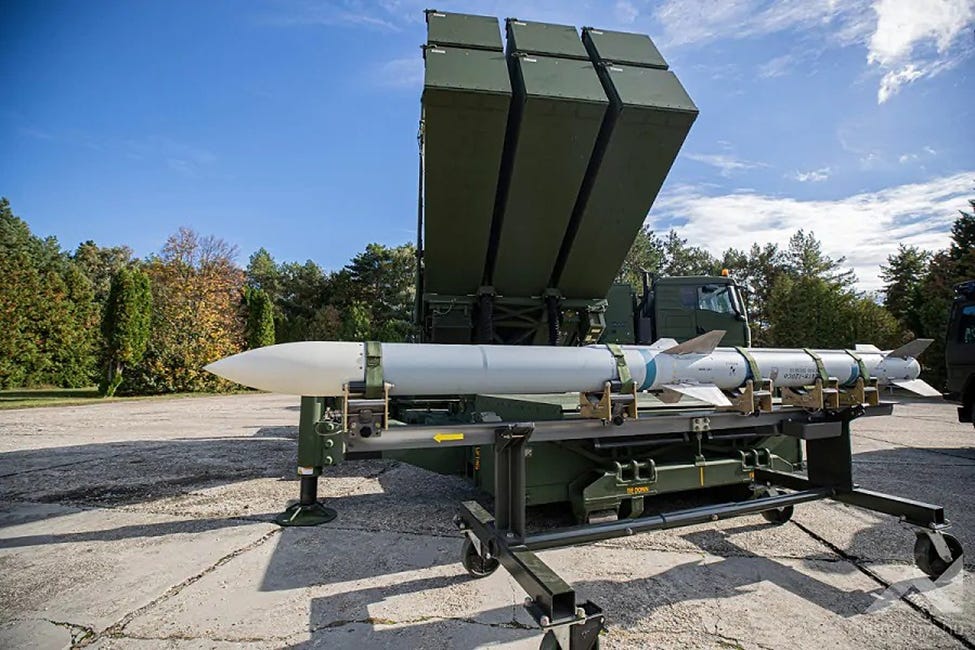
NASAMS could be considered “franken-sams”. They use canister-ized air-to-air missiles configured for surface launch.
A ballistic-capable interceptor lives or dies on terminal sensing and guidance. The objective is to maintain a reliable track and generate accurate endgame steering commands in seconds, often when the target is maneuvering, the background is cluttered, and the electromagnetic environment is contested. [11]
A useful benchmark is the architecture described for PAC-3 MSE in a publicly released Lockheed Martin briefing: an active Ka-band radar seeker, an inertial measurement unit, a guidance processor, and a multi-band RF datalink, paired with the ability to receive midcourse updates and then execute terminal homing. [6] An independent technical summary from the Center for Strategic and International Studies also describes PAC-3 as using an active Ka-band radar seeker and a forebody array of attitude control motors to achieve hit-to-kill maneuverability, with PAC-3 MSE adding an enlarged dual-pulse booster and other upgrades. [7] These sources help define what “ballistic-capable” implies at the seeker and guidance level, without requiring Ukraine to clone any single system. [6] [7]
A second benchmark is the U.S. Navy description of SM-6 development as a “low-risk approach” that combined a modified AMRAAM active seeker with the Standard Missile airframe, explicitly emphasizing reuse of non-developmental items to accelerate fielding. [8] This is directly aligned with FrankenSAM logic: combine a proven seeker lineage with an available propulsion and airframe family, then spend engineering effort on integration, software, and production. [8]
From these benchmarks, Ukraine’s seeker workstream can be framed around three non-negotiable capabilities.
First, autonomous terminal acquisition and tracking must be robust enough that the interceptor is not wholly dependent on continuous ground illumination or perfect radar conditions. [6] [7] This pushes toward an onboard active seeker for the ballistic mission set. [6] [7]
Second, the guidance package must tolerate high dynamics. That includes sensor stabilization, timing accuracy, and fast-control-loop execution so the missile can “convert” seeker measurements into usable steering commands under extreme closing speeds. [6] [10]
Third, the seeker must be integrated into a broader sensor and command architecture that provides early warning, cueing, and midcourse updates. CSIS’s missile-defense overview stresses that sensors and command-and-control underpin the entire intercept cycle, including early warning, tracking, fire control, discrimination, and kill assessment. [11] In practice, a Ukrainian interceptor that is “FrankenSAM-ready” should be designed to accept midcourse guidance from multiple possible radars and battle-management nodes, which reduces dependency on any single donated radar type and increases survivability under counter-battery pressure. [11] [22]
A practical bias-resistant conclusion follows: Ukraine’s advantage is not only hardware. The war has forced Ukraine to master mobility, concealment, and survivability tactics for high-value air defense assets, and U.S. Army officers have explicitly said the U.S. Army is learning from how Ukraine employs Patriot, including movement discipline and site survivability. [22] That same operational feedback loop can be embedded into seeker and guidance development, especially around countermeasures, decoy environments, and engagement sequencing under saturation. [22]
Once the seeker has a track, the missile must still “cash in” the intercept with control authority and energy. For terminal ballistic defense, this usually requires the ability to generate rapid lateral corrections late in flight, because small angular errors become large miss distances at high closing speeds. [6] [9]
The common modern design pattern is a hybrid control approach: aerodynamic control for efficient maneuvering where air density supports it, plus thrust-based control for rapid endgame corrections. The Lockheed Martin PAC-3 MSE materials describe a dual-control autopilot providing fast divert response via control fins and an attitude control section with attitude control motors, paired with a high-velocity hit-to-kill engagement profile. [6] CSIS similarly describes PAC-3’s forebody attitude control motors and active seeker as foundational to hit-to-kill maneuverability. [7]
A parallel European pattern is described by MBDA for ASTER, which combines aerodynamic control with direct force control using lateral thrusters near the center of gravity, emphasizing agility especially at high altitude. MBDA also notes a proximity fuze and a dual-mode blast-fragmentation warhead effective against challenging targets including tactical ballistic missiles. [7] This is not a prescription for Ukraine to copy ASTER, but it reinforces an engineering point: ballistic-capable interceptors typically need a maneuver system that remains effective when pure aerodynamic control becomes marginal, and they need lethality options that remain effective across target types. [7]
Divert and attitude control systems are the concept-level bridge between these examples and an indigenous Ukrainian interceptor. A U.S. Department of Defense technical piece describes DACS as fast-acting propulsion systems using small rocket thrusters to rotate or slightly shift vehicle orientation in short bursts, and it explicitly links that enhanced agility to successful target interception in military settings. [9] L3Harris similarly explains that DACS enables interceptors to fine-tune course and collide with targets, describing it as necessary for hit-to-kill intercepts against high-speed or maneuvering threats, and also notes use of a liquid divert and attitude control system for THAAD. [10] Together, these sources support a high-confidence requirement: if Ukraine’s goal is “most ballistic missiles,” an interceptor program needs a terminal control system with thrust-based agility, even if early prototypes start with simpler aerodynamic-only control for certain engagement classes. [9] [10]
Energetics sit beside maneuver as the second half of the endgame problem. The Lockheed Martin PAC-3 MSE description highlights rapid acceleration in boost and a sustain phase that maintains high velocity for hit-to-kill engagement, with a second pulse enabling longer-range or higher-altitude intercepts. [6] CSIS also describes PAC-3 MSE as using an enlarged dual-pulse booster to expand defended area and capability. [7] This is the key energetics lesson for Ukraine: terminal ballistic defense is often limited by time and kinematics, so sustaining usable velocity late in flight is as important as peak speed. [6] [7]
The implication for a Ukrainian FrankenSAM interceptor is straightforward at the program level. Ukraine should treat terminal control authority and late-stage energy as the core discriminators, then shape the rest of the missile around whichever of those constraints bites hardest in Ukrainian engagement data. [4] [11] This is also where Ukraine’s unique operational dataset is valuable: the system can be tuned against the specific ballistic profiles and countermeasures seen in-theater rather than generic test targets. [22]
FrankenSAM is fundamentally about interfaces: mechanical fit, electrical umbilicals, command-and-control messages, and logistic handling. Ukraine’s near-term advantage is that many relevant integration problems have already been solved in at least one direction, because FrankenSAM efforts have modified Buk-class launchers to fire Sea Sparrow family missiles and have produced other hybrid launch approaches. [1] [2] [3]
The War Zone reporting characterizes FrankenSAM as an umbrella effort blending Western interceptors and components with Soviet-era systems Ukraine already operates, and it describes multiple system variants including Buk paired with Sparrow or Sea Sparrow family missiles and a separate improvised AIM-9M-based system. [2] The Associated Press similarly describes a U.S.-improvised launcher assembled from radars and other contributed parts and describes Buk modified to fire RIM-7 missiles. [1] USNI adds context for Sea Sparrow integration within layered air defense. [3] These examples argue against any claim that “integration is the hard stop.” The integration pattern is already real, and Ukraine can build on it for a domestic interceptor by designing to common launch canister practices and standard command interfaces rather than bespoke launcher designs per radar type. [1] [2] [3]
On propulsion and packaging, canisterization and reliable field handling matter as much as raw motor performance. The Lockheed Martin PAC-3 MSE materials show canister-centric design thinking: the missile is single-packed, and launcher reconstitution is managed through standardized canister components and launcher electronics. [6] CSIS describes mixed loadouts on Patriot launchers and notes launcher variants supporting different canister types. [7] For Ukraine, the analogous program lesson is that a domestic interceptor should be designed for fast reload cycles, transport safety, and compatible storage life, because sustained defense against repeated raids is a throughput contest. [6] [7]
This launch-level discipline also interacts with survivability. Business Insider reported that U.S. Army officers learned from Ukraine’s Patriot employment, including mobility, camouflage, decoys, and physical adaptation of sites to increase survivability, which implies that a missile program should prioritize rapid setup and teardown and minimal exposed support equipment. [22] A “FrankenSAM-ready” interceptor should therefore be engineered with the assumption that launchers and support vehicles must frequently move, operate under deception, and accept mixed sensor cueing. [11] [22]
Finally, because missile defense effectiveness is sensor-bounded, Ukraine’s interceptor should be treated as one node in a broader kill chain. CSIS emphasizes that sensors and command-and-control span early warning through kill assessment. [11] A Ukrainian interceptor that can accept midcourse cueing from a variety of radars, including domestic and partner-provided systems, will be easier to scale than one that depends on a single proprietary radar or battle manager. [11] This is also where FrankenSAM thinking can expand beyond “launcher-plus-missile” and become “sensor-to-shooter interoperability,” increasing resilience and reducing vulnerability to single-point failures. [11]
Ukraine’s edge in this problem is the ability to compress learning cycles. A Chatham House analysis highlights Ukraine’s defense innovation ecosystem, including the government-backed Brave1 cluster launched in 2023 to streamline cooperation between startups, engineers, and military units, with real-time feedback from frontline forces enabling rapid battlefield test and refinement. [18] NATO also announced UNITE – Brave NATO as a joint NATO-Ukraine program to scale prototyped and tested innovative technologies, with Brave1 coordinating on Ukraine’s side and the NATO Communications and Information Agency executing the first competition, explicitly including air defense as a focus area. [17] These are institutional mechanisms that can be pointed at a ballistic-capable interceptor program to reduce the traditional gap between prototype and fieldable production. [17] [18]
Production credibility is already being established across adjacent categories. Reuters reported Ukraine’s expansion of arms production and stated capacity for millions of drones per year, while Ukrainian officials described rapid growth even under constant strikes. [14] Ukrainska Pravda reported an eightfold increase in cruise missile production in 2024 compared with 2023 and noted broader increases in domestically manufactured weaponry. [13] Ukrinform reported scale-up in Neptune missile serial production with 100 missiles produced in 2024, plus continuing development, which reinforces that Ukraine can run complex supply chains and serial manufacturing for advanced weapons. [12]
The financing model is also evolving toward exactly what an interceptor program needs. Ukraine’s defense ministry reported $6.1 billion in foreign funding for the defense industry in 2025 and described multiple channels, including partner-state direct procurement and the Danish model, along with an asserted $35 billion production capacity. [16] Separately, Reuters reported defense cooperation frameworks with Saudi Arabia that explicitly referenced foundations for future contracts, technological cooperation, and investments, and Reuters also reported Ukraine signing defense cooperation with Qatar and agreeing cooperation with the UAE, with explicit mention of discussions on co-production and raising funds to invest in weapons production. [19] [20] Reuters further reported Ukraine framing these engagements as exporting its defense system and expecting corresponding cooperation around air defense and defense production. [21]
For a ballastically capable FrankenSAM interceptor, this suggests a financing and governance pattern that plays to Ukraine’s strengths.
A first track is an indigenous “core interceptor” program where Ukraine owns the integration, flight software, and system interfaces, while selectively partnering for components that are hardest to localize quickly, especially specialized seeker elements and certain propulsion subsystems. [6] [11] [17] A second track is joint venture production or consortia specifically oriented toward counter-ballistic capability, which Ukraine’s defense minister has already floated publicly, while emphasizing Ukraine’s independent counter-ballistic potential. [4] A third track is export-aware design: even if wartime needs dominate initial output, designing to partner-operable interfaces increases the likelihood of sustained foreign production financing because a partner can co-produce for its own needs later, not only as a donation pipeline. [16] [19] [21]
The investment logic is therefore tied to observable progress markers rather than speculation. In practice, a credible program would demonstrate repeatable component performance, integration stability across at least one legacy launcher pathway, and a clear path to rate production that aligns with Ukraine’s wartime manufacturing style. [1] [2] [14] [18] Each of these markers can be financed through mechanisms already described by Ukraine’s defense ministry and through the kinds of technology-and-investment language present in Ukraine’s recent Gulf defense cooperation announcements. [16] [19] [20]
Benjamin Cook continues to travel to, often lives in, and works in Ukraine, a connection spanning more than 15 years. He holds an MA in International Security and Conflict Studies from Dublin City University and has consulted with journalists and intelligence professionals on AI in drones, U.S. military technology, and open-source intelligence (OSINT) related to the war in Ukraine. He is co-founder of the nonprofit UAO, working in southern Ukraine. You can find Mr. Cook between Odesa, Ukraine; Charleston, South Carolina.
[1] Associated Press, “Pentagon’s ‘FrankenSAM’ program cobbles together air defense weapons for Ukraine,” Oct. 12, 2023. Source: . Note: Defines FrankenSAM and cites Buk-to-RIM-7 and AIM-9M launcher work.
[2] The War Zone, “FrankenSAM systems are now shooting down drones in Ukraine,” Jan. 17, 2024. Source: . Note: Describes deployed FrankenSAM variants and a reported Shahed-type intercept.
[3] USNI News, “U.S. sending Ukraine Sea Sparrow missiles in latest aid package,” Jan. 6, 2023. Source: . Note: Confirms Sea Sparrow provision and layered air defense framing.
[4] Reuters, “Ukraine may form joint ventures with allies to boost defenses against ballistic missiles,” Feb. 27, 2026. Source: . Note: States Patriot’s ballistic-defense role, PAC-3 shortage, and Ukraine’s stated counter-ballistic potential.
[5] Reuters, “Lockheed Martin wins $9.8 billion Patriot missile contract,” Sept. 3, 2025. Source: . Note: Reports PAC-3 MSE unit cost estimate and procurement scale.
[6] Lockheed Martin, “PAC-3 MSE overview” (public release briefing slides, 2024). Source: . Note: Cites active Ka-band seeker, IMU, datalink, dual-control approach, and two-pulse motor concept.
[7] Center for Strategic and International Studies, “Patriot” system profile (Missile Threat), Aug. 23, 2023. Source: . Note: Summarizes PAC-3 active Ka-band seeker and attitude control motors, plus PAC-3 MSE dual-pulse booster framing.
[8] U.S. Navy, “Standard Missile” fact file, updated page accessed 2026. Source: . Note: Describes SM-6’s reuse of an AMRAAM active seeker on a Standard Missile airframe as a low-risk approach.
[9] U.S. Department of Defense, “Divert and attitude control systems (DACS)” technical feature, Jan. 27, 2023. Source: . Note: Defines DACS as fast-acting thruster systems that enable interception agility.
[10] L3Harris, “Divert and attitude control systems,” capability page accessed 2026. Source: . Note: Explains DACS necessity for hit-to-kill style intercepts and related functions.
[11] Center for Strategic and International Studies, “Sensors and command and control” (Missile Threat), Apr. 7, 2017. Source: . Note: Explains sensor and C2 roles across the intercept cycle.
[12] Ukrinform, “Ukraine scales up advanced Neptune missile production,” Nov. 18, 2024. Source: . Note: Reports first 100 missiles in 2024 and serial production scale-up.
[13] Ukrainska Pravda, “Ukraine increased cruise missile production eightfold in 2024,” Apr. 12, 2025. Source: . Note: Reports eightfold cruise missile production growth and broader domestic output claims.
[14] Reuters, “Ukraine ramps up arms production, can produce 4 million drones a year, Zelenskiy says,” Oct. 2, 2024. Source: . Note: Documents rapid domestic production expansion under wartime conditions.
[15] Reuters, “Ukraine begins mass production of interceptor drones to bolster air defense,” Nov. 14, 2025. Source: . Note: Describes low-cost interceptors as a way to conserve expensive missiles for cruise and ballistic threats.
[16] Ministry of Defence of Ukraine, “The Ministry of Defence secured over $6 billion for Ukraine’s defense industry in 2025,” Jan. 3, 2026. Source: . Note: Reports foreign funding totals and mechanisms, plus stated production capacity.
[17] NATO, “NATO and Ukraine announce UNITE – Brave NATO,” Nov. 26, 2025. Source: . Note: Describes NATO-Ukraine program to scale tested innovation, including air defense.
[18] Chatham House, “What Ukraine can teach Europe and the world about innovation in modern warfare,” Mar. 5, 2025. Source: . Note: Describes Brave1 and rapid feedback-driven iteration.
[19] Reuters, “Ukraine and Saudi Arabia sign deal on defense cooperation, Zelenskiy says,” Mar. 27, 2026. Source: . Note: Mentions foundations for contracts, technology cooperation, and investment.
[20] Reuters, “Ukraine agrees defense cooperation with the United Arab Emirates and Qatar,” Mar. 28, 2026. Source: . Note: Describes co-production discussions and intent to raise funds for domestic production.
[21] Reuters, “Ukraine’s Zelenskiy says Middle East visit a success, announces accords,” Mar. 30, 2026. Source: . Note: Frames Ukraine as exporting defense know-how and seeking reciprocal cooperation on air defense and production.
[22] Business Insider, “Ukraine made the Patriot a moving target and taught the US Army to fight smarter,” Jul. 11, 2025. Source: . Note: Reports U.S. Army learning from Ukraine’s air defense employment tactics, including mobility and survivability.
This text is published with the permission of the author. First published here.