ENG

Residents of Sevastopol describe their current lives as “Groundhog Day.” Every morning, the occupation administration announces that electricity will be supplied today according to a schedule — say, 2/6. A power supply schedule for the city’s districts is published — and not once has it been followed. Power company officials say it’s impossible to stick to the schedules right now — the electricity shortage is simply too severe. Vasyl Georgiyovych, a former employee of “Krymenergo,” confirms that it’s truly impossible to implement any kind of schedule at this time. The amount of electricity reaching the peninsula is catastrophically low. Therefore, it has to be distributed manually to prevent the entire power grid from “crashing.”
“Look, let’s say I’m a dispatcher; I have 1,000 MW, and I need to distribute it. I calculate: okay, I’ll cut off power to Feodosia for two hours, then to Kerch for two, and then restore it to Feodosia. In other words, a rotation schedule is possible when we know how much capacity we have at our disposal. But how much do we have right now? I don’t know, and nobody knows — not even approximately — because the main transmission facilities are damaged. And dispatchers have to
quickly adjust the grid configuration, taking into account the condition of specific lines, substations, and power flows. I understand it’s inconvenient for people. But this really is one of those cases where there’s nothing we can do.”
Marina, a resident of Sevastopol, says she’d gladly believe this explanation if it weren’t for one “but.” In the upscale high-rises — unlike her Khrushchev-era apartment building — the lights don’t go out.
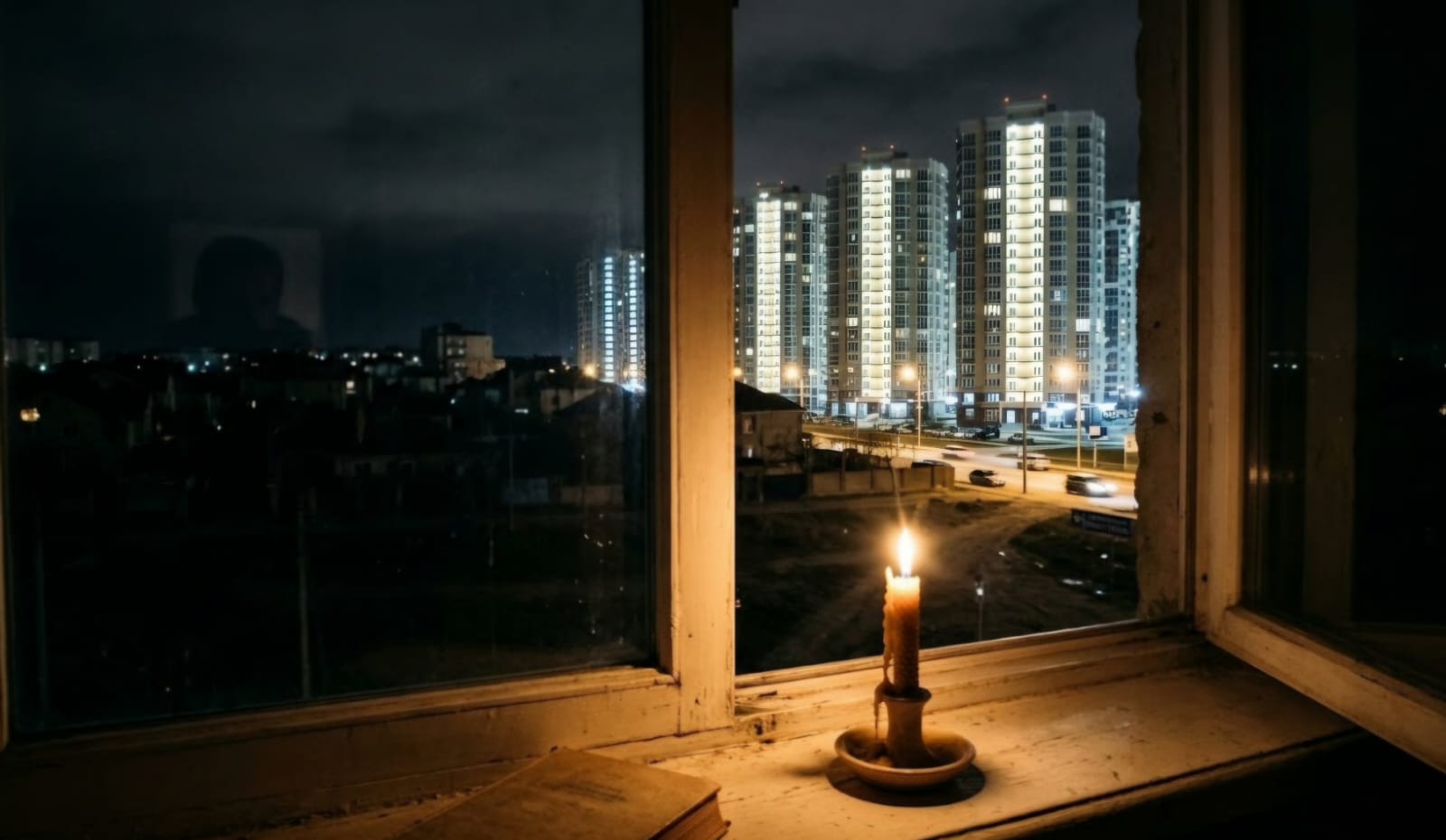
“When I come home from work, I drive past the high-rises on Marinesko. These are supposed to be luxury buildings. Well, ‘luxury’ — the ‘Ponaikhi’ (Russians — Ed.) bought up apartments there, and the soldiers are paying off their mortgages. So, while I’m scrambling for electricity at night just to do some laundry or vacuum, those high-rises are a total ‘disco party.’ I haven’t seen them dark a single evening,” the woman complains.
Because of the lights, Crimeans are arguing with each other en masse on social media. Neighborhood against neighborhood, city against city — those whose homes aren’t without power are being criticized by those sitting in the dark. Sevastopol residents are complaining to Simferopol residents about the lit sidewalks. Simferopol residents, in turn, defend themselves: “You haven’t been to Yalta in a long time; there, even some billboards are lit up.” “Nothing of the sort,” Yalta residents retort indignantly, posting a photo from a children’s hospital as proof, where patients are being examined with a flashlight. “Where were you all when we lived without electricity or water for a month and a half this summer?” — residents of Dzhankoy interject into the argument. Now, residents of Kerch find themselves in the same situation: since Sunday, the city has been cut off not only from electricity but also from the water supply. And the only schedule in effect here is the water delivery schedule. That’s why Kerch residents are now asking in online forums why only their taps are dry, and not those across the entire peninsula.
“It’s not envy. Or rather, it’s not just that,” says psychologist Tetyana, who herself rarely sees the lights on in her home in a suburb of the Crimean capital these days. According to Tetyana, Crimeans are simply utterly exhausted — by the prolonged uncertainty, the inability to make even the slightest plans, and, most importantly, the total injustice that has reigned in Crimea for the past 12 years.
“Arguments over electricity aren’t just arguments over electricity. When people find themselves in a situation of helplessness and instability for a long time, a mundane problem very quickly becomes an emotional one. And blaming a neighbor for having electricity while you don’t is a typical mechanism for redirecting frustration: when the real cause of the problem is out of reach, negative emotions are directed at those within reach. “That’s why the real issue isn’t the power itself, but the sense of injustice and powerlessness we’re all living with here,” the psychologist explains.
Meanwhile, in Sevastopol, the power schedule was released again this morning. And this illusion of control is already annoying people perhaps even more than the darkness itself.